
Reviewed · WALKING TOURS IN VIENNA
Vienna: Private Guided Walking Tour
Vienna’s grand center becomes much more interesting when someone connects the palaces, churches, cafés, and strange little stories. This private walking tour lets you shape the route for your own group, with stops ranging from the Habsburg court to old courtyards and the house where Mozart died. I like that you can ask questions as you go instead of keeping pace with a large crowd.
I also like the strong mix of famous sights and human details. You’ll hear about Empress Sisi, Josef II, Richard the Lionheart, Sachertorte, Wiener Schnitzel, and the old ways of life in Blutgasse. The guides Herbert S. and Herbert Stojaspal are associated with especially well-regarded tours, and Herbert S. has been praised for excellent English, humor, and a well-paced three-hour route.
The main consideration is that this is an outdoor walking tour with no entrance fees included. It takes place in all weather, does not suit people with mobility impairments, and the shorter booking options may not allow time for every sight listed. Confirm the exact duration and route before you pay.
Key points to know before you book
- A genuinely private format: The guide works only with your group, up to 10 people, so you can ask questions and set priorities.
- Vienna’s imperial center in one walk: The route can include the Hofburg, Heldenplatz, Josefsplatz, the Spanish Riding School, the Albertina, and the Imperial Crypt.
- More than palace facts: Expect stories about Sisi, Josef II, Mozart, Richard the Lionheart, Sachertorte, and Viennese eating habits.
- A flexible length: The information describes options from 1 to 4 hours, while the booking details list 2 to 4 hours. Check the selected time carefully.
- English or German only: A state-licensed local guide leads the tour in one of these two languages.
- A good central meeting point: Most groups meet beside the Lindt Chocolate Store on Stephansplatz, with hotel pickup limited to hotels in postal zone 1010.
Why a private walk works well in central Vienna
Vienna’s historic center is compact enough to explore on foot, but its buildings can blur together if you do not know what you are seeing. One palace façade leads to a church, then a monument, then a pastry shop with another layer of imperial history. A guide gives those places order and meaning.
The private setup is the real selling point. You are not listening over a large group or waiting for strangers who want photographs. If your group is interested in architecture, Habsburg rulers, Jewish and Roman Vienna, food, or local legends, you can ask the guide to give that subject more time.
The price is $270 per group of up to 10 people. For a full group, that can be a sensible deal, especially compared with paying separate per-person fees for several shorter activities. For two people, it is a much larger expense, so the value depends on how much you care about personal attention and route planning.
The tour is led by a state-licensed local guide and is offered in English or German. The guide can explain the city’s major sights while also pointing out details that are easy to miss, such as old courtyards, changing street life, and buildings with surprising pasts.
More Walking Tours in Vienna
- Vienna: Guided Walking Tour of City Center Highlights
★ 4.7 · 4,989 reviews - Vienna: Vienna Central Cemetery Guided Walking Tour
★ 4.8 · 3,307 reviews - Vienna: Guided Walking Tour of City Highlights & Hidden Gems
★ 4.9 · 2,180 reviews
Stephansplatz and the first look at Vienna
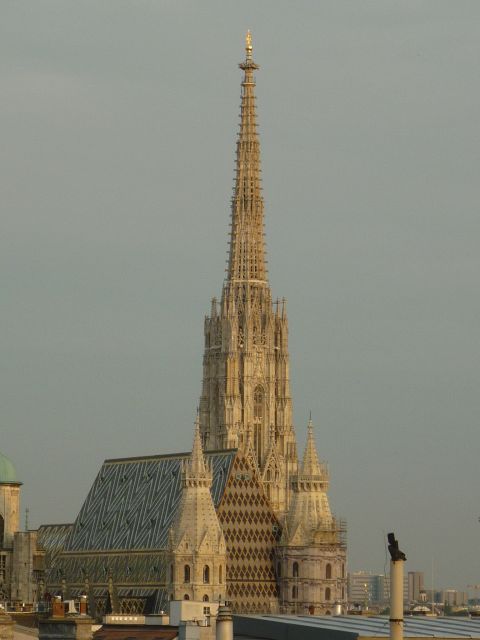
The meeting point is at St. Stephen’s Square, beside the Lindt Chocolate Store at the corner of Stephansplatz 8A and Jasomirgottstrasse. This is a useful place to begin because St. Stephen’s Cathedral gives you an immediate sense of Vienna’s scale and age.
The square is also easy to reach. Use the U1 or U3 subway lines and leave at Stephansplatz, using the Stephansplatz exit. Buses A1, A2, and A3 also stop nearby. If your hotel is in postal zone 1010, pickup may be available. For other districts, you should plan to meet at the square.
The tour can finish back near the starting point after a stroll through Kohlmarkt. That makes it convenient for continuing into the center, though you should not assume that every stop listed will be visited during the shortest version.
Graben, Kohlmarkt, and Vienna’s grand public face
From Stephansplatz, the route reaches the Graben, one of Vienna’s best-known streets. This is where the city presents its polished imperial side, with elegant façades, shops, and the ornate Pestsäule, or Plague Column.
The guide ties the monument to stories about Richard the Lionheart and Vienna’s medieval past. These small connections make the walk more lively than a simple sequence of dates and building names.
Kohlmarkt continues the formal parade toward the Hofburg. You’ll pass Demel, the famous pastry shop, and hear about the Viennese love of coffee, cakes, and courtly ritual. If food matters to you, the guide can also explain where Sachertorte was invented and what stood on the site now occupied by Hotel Sacher.
These streets are attractive but busy, especially during the day. You will have more room for conversation in the narrower side streets, and the private format helps when you want to pause without holding up a large group.
Michaelerplatz and the Hofburg’s imperial stories
Michaelerplatz offers one of the tour’s best contrasts. Roman and medieval excavations sit beside grand Baroque and historicist buildings, showing how Vienna was built layer upon layer. You may also visit the interior of St. Michael’s Church if the selected route and timing allow.
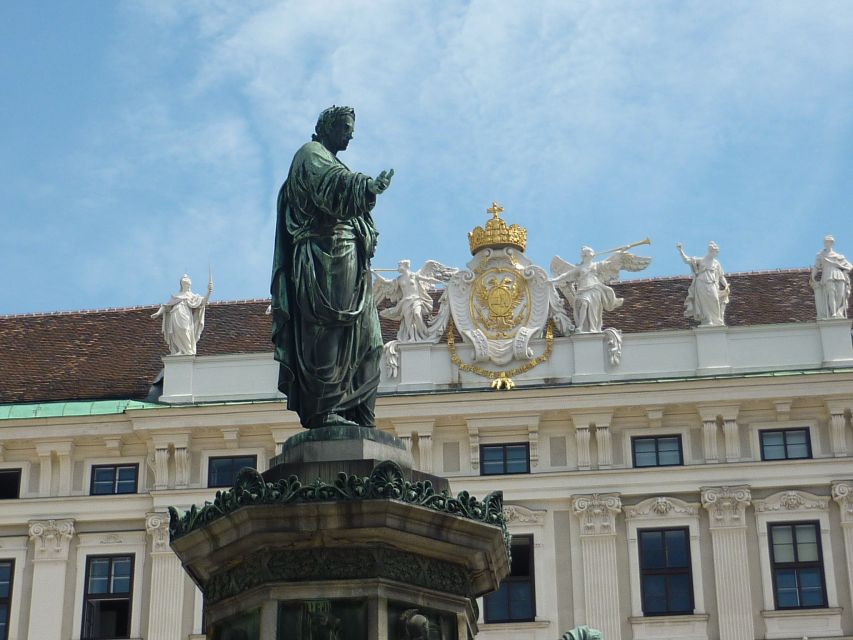
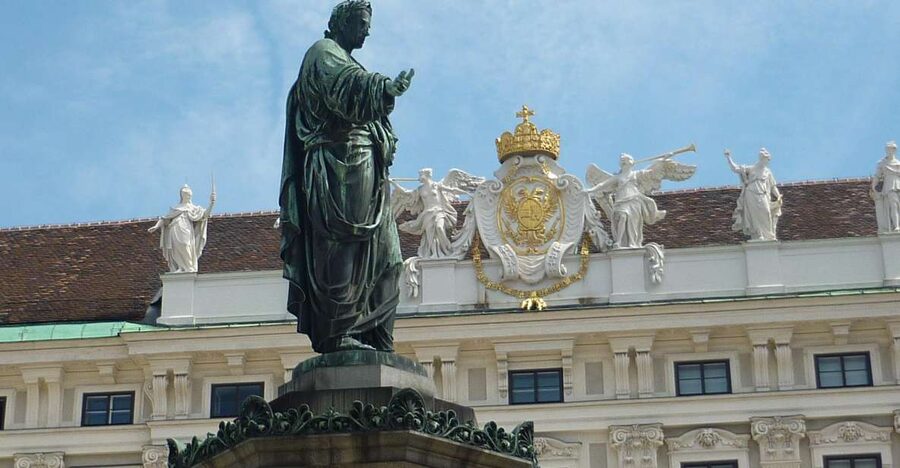
From here, the guide leads you toward the Hofburg Palace, the former center of Habsburg power. The palace complex is not one single building with one simple purpose. It is a group of courtyards, wings, churches, offices, and ceremonial spaces formed over centuries.
The tour focuses on the people behind the palace walls. Empress Sisi is a major figure, and you’ll hear true stories about her life rather than only the romantic version presented in films and souvenirs. The guide also explains the Habsburgs and the court traditions that shaped Vienna.
Do not confuse a guided walk past the Hofburg with an interior palace tour. Entrance fees are not included, so you should ask exactly which interiors are planned if seeing the inside is important to you.
A different way to spend an afternoon here:
- Vienna: Vivaldi’s Four Seasons Concert in Karlskirche
★ 4.7 · 14,951 reviews - Vienna: Spanish Riding School Training
★ 3.9 · 9,281 reviews - Vienna: Skip-the-cashier-desk-line Giant Ferris Wheel Ride
★ 4.5 · 7,859 reviews - Vienna: Schönbrunn Palace & Gardens Skip-the-Line Tour
★ 4.7 · 7,739 reviews
The Spanish Riding School, Heldenplatz, and Josefsplatz
The Spanish Riding School is one of the most famous institutions in the Hofburg area. On this walk, you can see the setting and learn about its place in imperial Vienna. A performance or stable visit is not included, so fans of the Lipizzaner tradition should treat this as an exterior introduction rather than a full riding-school experience.
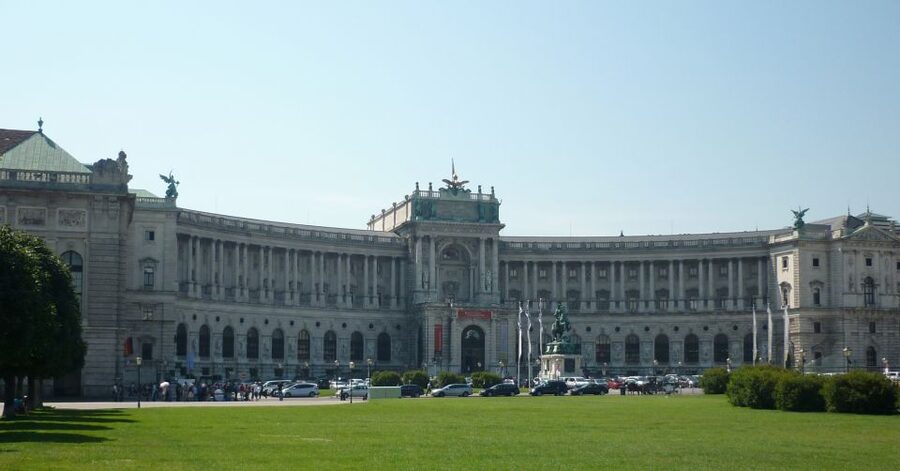
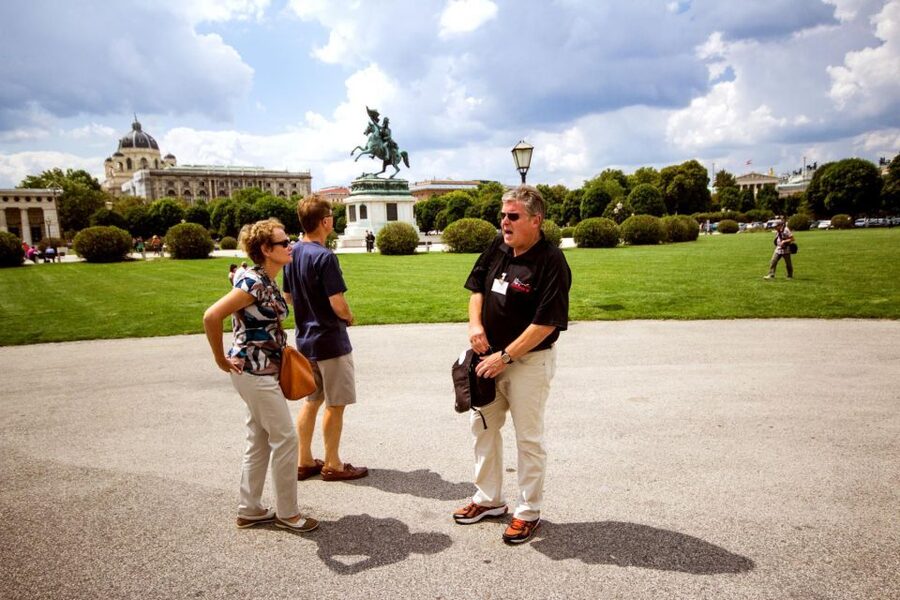
Heldenplatz opens out beside the Hofburg and offers a broad view of Vienna’s imperial architecture. The guide uses the square to tell stories about Austrian heroes and the events connected with this symbolic space. It is a good place to understand how architecture and national memory work together.
At Josefsplatz, the focus shifts to Josef II. The guide also discusses the Austrian National Library, the Augustinian Church, the Habsburgs, and the court world connected with these buildings.
The National Library is worth seeing even from outside, but entrance is not part of the tour price. If you want time inside the grand state hall, plan a separate visit and make sure the walking route leaves you enough energy and time.
Albertina, the State Opera, and a darker memorial
The walk continues past the Albertina Museum, known for its enormous graphic collection. You’ll also see the Monument Against War and Fascism, a modern memorial that changes the tone of the tour.
This section shows why a city walk can be more useful than a palace-only visit. Vienna’s center is not just a display of imperial wealth. It also contains reminders of war, dictatorship, and the difficult parts of Austrian history.
The nearby State Opera brings another unusual story. The guide explains why the opera house’s architect committed suicide, giving you a personal and tragic detail behind a building many people simply photograph.
The tour does not include admission to the Albertina or the State Opera. If you want to see an exhibition or attend a performance, treat the walking tour as an orientation and return later with a reserved ticket.
Hotel Sacher, Neuer Markt, and the Imperial Crypt
Hotel Sacher is one of the city’s most famous addresses, and the tour uses it to explain the story of Sachertorte and the building’s earlier use. This is the sort of stop that works well for curious visitors who want food history linked to the streets around them.
At Neuer Markt, the subject turns to the Imperial Crypt, the burial place of many Habsburg rulers. The guide explains the unusual burial customs of the dynasty, which are both solemn and oddly specific.
The crypt is a paid interior attraction, and the entrance fee is not included. If you want to go inside, ask whether the timing of your private walk permits it. The guide’s explanation outside can still help you understand why the site matters, but it is not the same as seeing the tombs yourself.
The route also covers where Mozart died. That detail helps move the story beyond the imperial court and into Vienna’s musical past. The city’s famous composers are not treated as isolated names. Their homes, workplaces, patrons, and final addresses are part of the urban story.
Blutgasse, Franziskanerplatz, and everyday Vienna
The narrower streets provide some relief from the formal boulevards. In Blutgasse, the guide explains how ordinary people once lived and how the area functions today. The supplied tour details also point to beautiful courtyards, and one German-language account specifically praised the chance to see attractive Viennese back courtyards.
You should not expect a museum-style reconstruction of daily life. Instead, you get clues in the street plan, façades, and old buildings. That makes this section especially useful after the palace stops, since it shows the city beyond emperors and grand ceremonies.
Franziskanerplatz brings another local story, while the old university district adds more background on Vienna’s intellectual and religious life. The exact stops depend on your selected duration and the interests you give the guide.
St. Rupert’s Church and the Greek quarter
The longer route can reach Vienna’s Greek quarter and St. Rupert’s Church, identified as the city’s oldest church. This part of the walk reaches farther from the main Hofburg circuit and gives you a different view of the center.
Here, the guide connects Roman Vienna with the later history of Jewish communities and the city’s changing population. That broader story matters because Vienna was never only a Habsburg court town. Its streets were shaped by merchants, students, religious groups, immigrants, and residents living ordinary lives.
This section is a strong reason to choose a longer tour. A one or two-hour outing may concentrate on the central imperial sights, while a three or four-hour route has more room for the Greek quarter, St. Rupert’s, the old university district, and the less formal streets.
What the guide style may be like
The guide style can vary because this is a private booking, but the named guide Herbert S. has been praised for clear English, helpfulness, humor, and a well-paced three-hour walk. One particularly personal touch involved finding a historic photograph of a guest’s Airbnb building and explaining its former use as a brothel.
That anecdote gives you a useful clue about the best version of this tour. The guide may do extra research around your lodging or interests, but you should not assume that this exact preparation is guaranteed. If you want local stories about your hotel or neighborhood, ask when booking.
The German-language feedback points to a more factual presentation for at least one group. That is not necessarily a problem, but it suggests you should tell the guide if you prefer a more conversational style, more architecture, more social history, or more humor.
Timing, weather, and practical limits
The tour is offered in all weather, so wear proper shoes and bring clothing suited to the forecast. Vienna’s center has plenty of hard walking surfaces, and the experience is not suitable for people with mobility impairments.
The supplied details describe choices from 1 to 4 hours, while the activity information also states 2 to 4 hours. That difference matters. A short version cannot reasonably give equal attention to St. Stephen’s Cathedral, the Graben, Kohlmarkt, Hofburg, Albertina, Imperial Crypt, old university district, Greek quarter, and St. Rupert’s Church.
At booking, state an alternative preferred time if needed. The tour normally runs in English or German only. Large bags, luggage, skateboards, and skates are not allowed, and smoking is not permitted. Photography inside is also prohibited, so follow the guide’s instructions at churches or other interiors.
The price excludes entrance fees, personal spending, and gratuity. Build those costs into your plan if you hope to enter the Imperial Crypt, National Library, Albertina, or another paid attraction.
Who gets the best value from this Vienna tour
I would recommend this for a family, group of friends, or colleagues who want a flexible introduction to Vienna without sharing the guide. It also suits first-time visitors who want the major sights explained before exploring the city on their own.
The tour is particularly useful if you enjoy questions and side stories. You can ask why a building was designed a certain way, how Habsburg customs worked, where Mozart died, or how Viennese food became part of the city’s identity.
It is less suitable if you want a fast checklist of interiors or a guided visit to a single museum. Since entrance fees are separate and the experience is mostly on foot, a museum-focused visitor may get better value from booking individual admissions and visiting at leisure.
For a full group of up to 10, $270 is reasonable for a private guide covering central Vienna. For a couple, the cost is harder to justify unless personal attention and a custom route are worth more to you than a lower-priced shared walk.
Should you book it?
Book this tour if you want Vienna explained through people, places, and stories rather than only photographed from the outside. The strongest parts are the private format, the option to adjust the focus, and the mix of imperial landmarks with courtyards, food lore, Roman remains, Jewish history, and everyday streets.
Before booking, confirm the exact duration, language, meeting point, and whether any interior visit is included in your chosen plan. If your group can fill most of the 10-person limit, the price becomes much easier to defend. If you need step-free access, carry large luggage, or want a museum admission included, choose another arrangement.
FAQ
How much does the private Vienna walking tour cost?
The tour costs $270 per private group of up to 10 people.
How long does the tour last?
The available information describes tour choices from 1 to 4 hours, while the booking details list 2 to 4 hours. Confirm the exact duration when selecting your time.
Is the tour private?
Yes. The tour is for a private group, with a maximum group size of 10 people.
Which languages are available?
The tour is available in English or German. Other languages are not offered.
Where does the tour meet?
The regular meeting point is at St. Stephen’s Square, 1010 Vienna, at Stephansplatz 8A near the corner of Jasomirgottstrasse, beside the Lindt Chocolate Store.
Is hotel pickup available?
Hotel pickup is available only if your hotel is in postal zone 1010. Hotels in other postal zones use the meeting point at St. Stephen’s Square.
Are entrance fees included?
No. Entrance fees, personal expenses, and gratuity are not included in the tour price.
Does the tour operate in bad weather?
Yes. Tours take place in all weather conditions, so bring weather-appropriate clothing.
Is the tour suitable for people with mobility impairments?
No. The experience is listed as unsuitable for people with mobility impairments. Large bags, luggage, skateboards, and skates are also not allowed.
Recently added around Vienna
- Vienna: Private tour Mauthausen and Linz★ 4.1 · 3 reviews
- 2-Day Prague Tour from Vienna with private Transfers and Lunches★ 5.0 · 3 reviews
- Vienna Self Guided Sherlock Holmes Murder Mystery Game★ 4.5 · 3 reviews
- Vienna Private Schönbrunn Palace Tour, Extra Rooms and Gardens★ 5.0 · 3 reviews
- Salzburg and Lake Region Private Day Trip from Vienna★ 5.0 · 3 reviews
- Small-group Vienna Wine Tour★ 5.0 · 3 reviews
- True Crime mobile puzzle rally Vienna★ 4.0 · 3 reviews
- Vienna: Wachau Valley Private Kayak and Wine Tour★ 5.0 · 3 reviews
Walking Tours in Vienna, compared.

Guided Walking Tour of City Center Highlights
Read our review →
Guided Walking Tour of City Highlights & Hidden Gems
Read our review →
Vienna Historic Center Small Group Walking Tour
Read our review →


Ghosts and Legends Guided Nighttime Walking Tour
Read our review →

Browse the lists this tour appears in