
Reviewed · SPANISH RIDING SCHOOL TICKETS
Vienna: Spanish Riding School Training
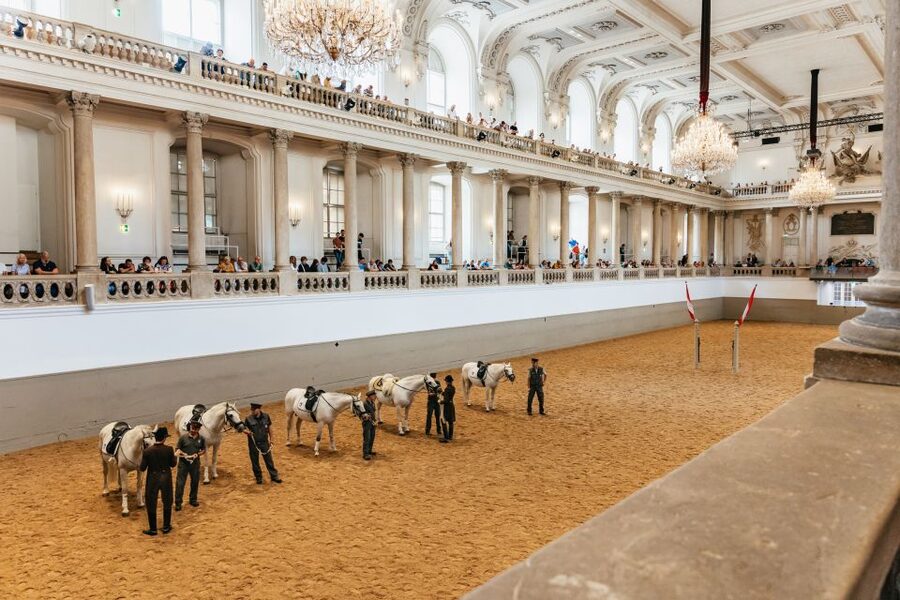
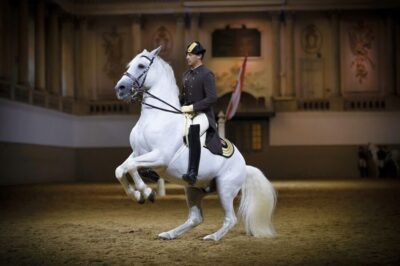
The Spanish Riding School’s morning exercise gives you something a full performance cannot: a look at the daily work behind the famous white stallions. In the Baroque Winter Riding Academy, you watch horses and riders repeat basic movements, build strength, and refine control to classical Viennese music. The famous levade, courbette, and capriole may appear, but they are not practiced every day.
I like the beautiful historic arena and the chance to see several horse-and-rider teams at different stages of training. I also like the price: at $20 for an hour, this is a smart alternative when performance tickets are sold out. The main drawback is that the session is practice, not a polished show, so you may see plenty of trotting and basic dressage but none of the spectacular school jumps.
Key points to know before you go
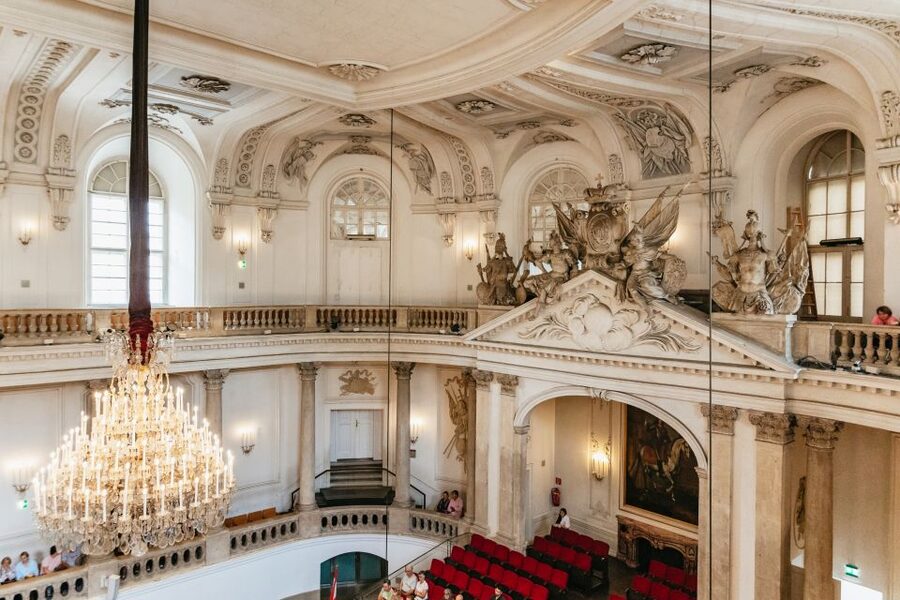
- The setting is part of the attraction: Chandeliers, Baroque architecture, and the famous Winter Riding Academy frame the training session.
- Training is not a full performance: Expect relaxation exercises, dressage, muscle work, and movement practice. Advanced jumps are occasional.
- You may watch two groups: The hour can include separate sessions, with horses and riders of varying ages and abilities.
- Standing tickets can be good value: They cost less, but standing for an hour may be tiring, especially for anyone with mobility issues.
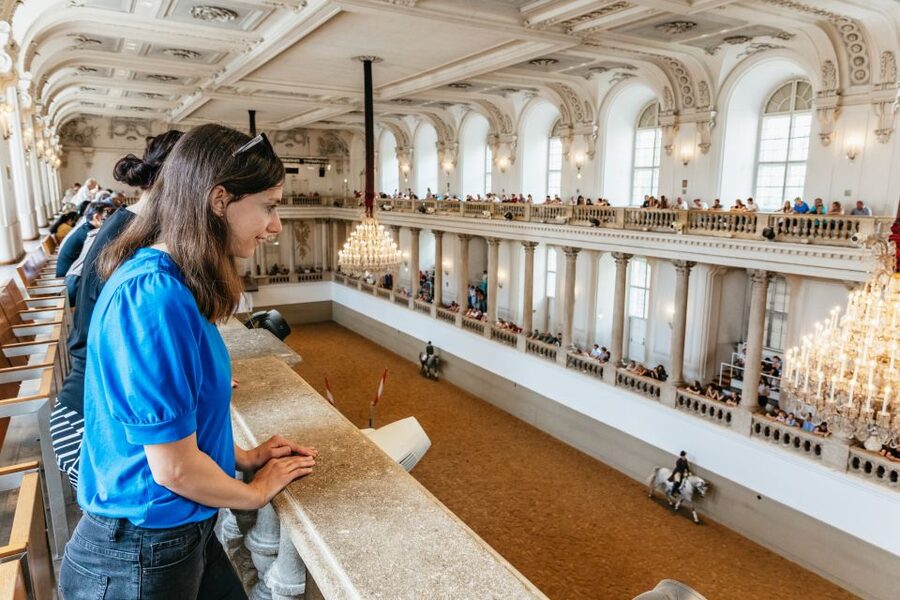
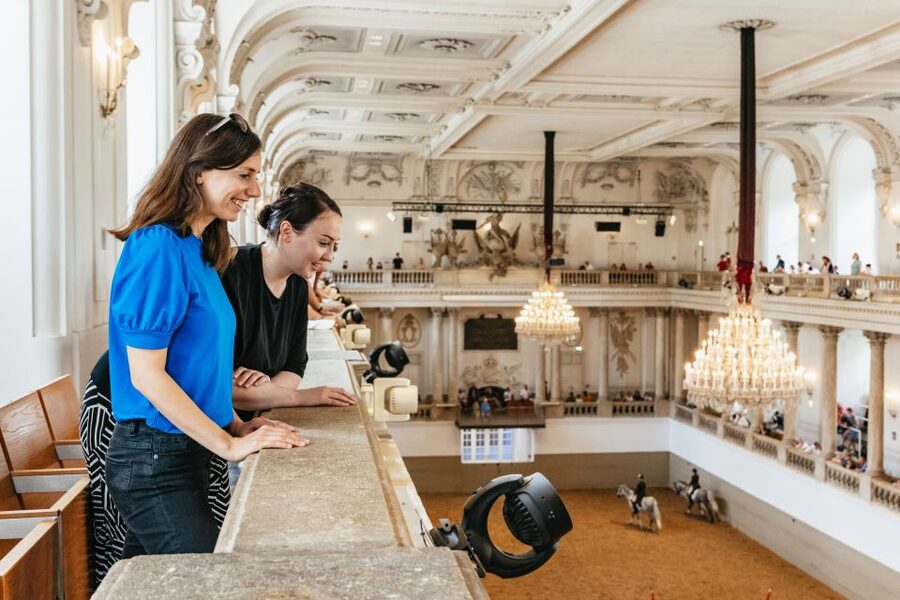
- Arrive early for a decent position: Some areas have obstructed views, and upper seating can require leaning over a high wall.
- Photography and video are forbidden: Staff make repeated announcements, so keep your phone away during the exercise.
What the morning exercise really is
The morning exercise is the working day of the Spanish Riding School, not a shortened theatrical performance. The white Lipizzaner stallions are trained almost every day, and the goal is to keep them healthy, athletic, responsive, and strong enough for the demanding movements of the haute école.
That distinction matters. You may arrive expecting a parade of rearing horses and dramatic leaps. Instead, you could see riders working on transitions, changes of lead, sidesteps, lunging, walking, and controlled trotting. These basic movements may look modest, but they are the foundation for the advanced work shown in formal performances.
I find this more revealing than a show in one important way. You can watch the partnership being built rather than only the finished result. A young rider may receive closer instruction, while a more experienced horse works through familiar exercises with a quieter hand.
The program can include relaxation work, movement refinement, and exercises designed to strengthen particular muscle groups. The riders are not simply putting the horses through random drills. Each repetition has a purpose, even if that purpose is not always obvious from the balcony.
More Spanish Riding School tickets:
- Vienna Spanish Riding School Guided Tour
★ 4.7 · 6,765 reviews - Performance Of The Lipizzans At Spanish Riding School
4,190 reviews - Vienna: Spanish Riding School 45-Minute Performance Show
★ 3.9 · 731 reviews
Inside the Winter Riding Academy
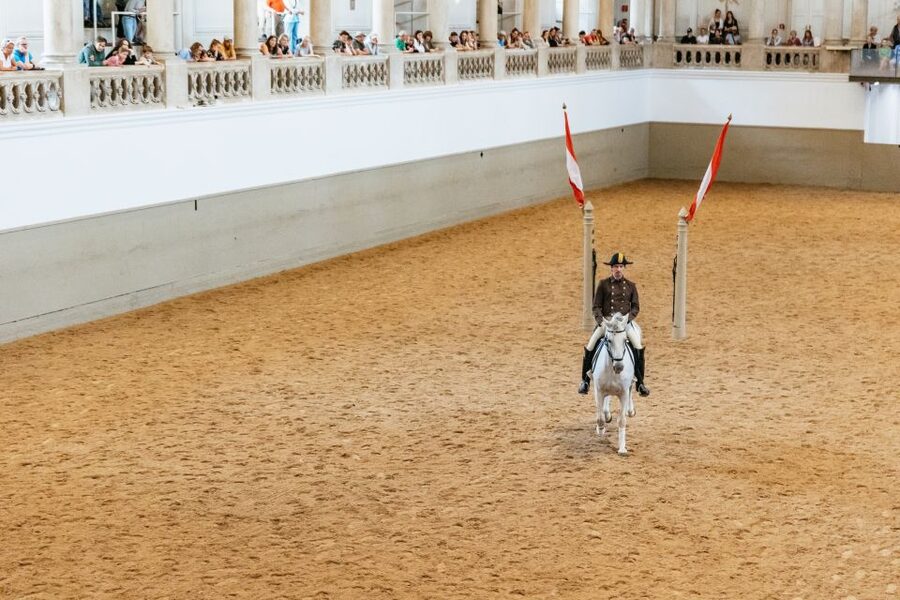
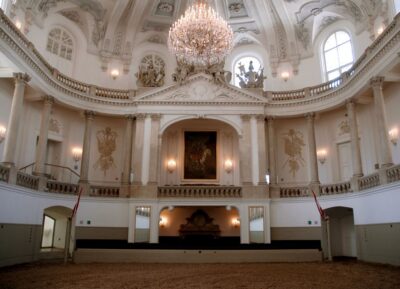
The Winter Riding Academy is a major reason to book this activity. The horses work in a grand Baroque hall beneath chandeliers, an unusual contrast to the plain sand arena below. The building has long been connected with Vienna’s imperial court, and its scale gives even a routine training session a sense of occasion.
You may hear a commentary explaining the school, the horses, and the training process while Viennese classical music plays in the background. The commentary helps explain why different riders wear different uniforms and why some horse-and-rider teams appear more polished than others.
Sound quality can vary by seat. From the upper levels, the narration may be muffled or difficult to follow, especially when several horses are moving at once. If the explanation matters to you, a middle section may be a better choice than the highest tier.
The arena itself is easier to appreciate from a seat with a broad view. Some upper-side positions offer a good look at one part of the floor but leave another area partly hidden. If staff allow you to move to a more open position, take advantage of it. Your view can make a real difference during an hour of repeated exercises.
A typical one-hour session
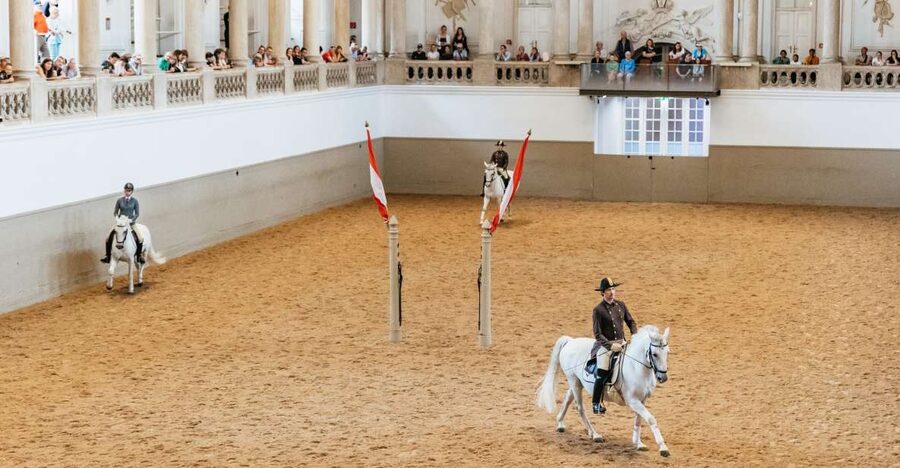
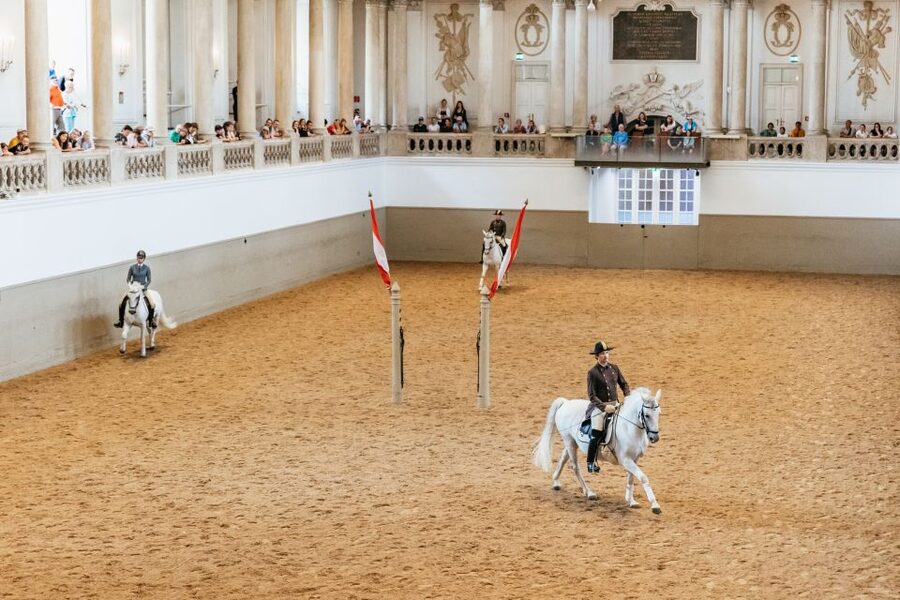
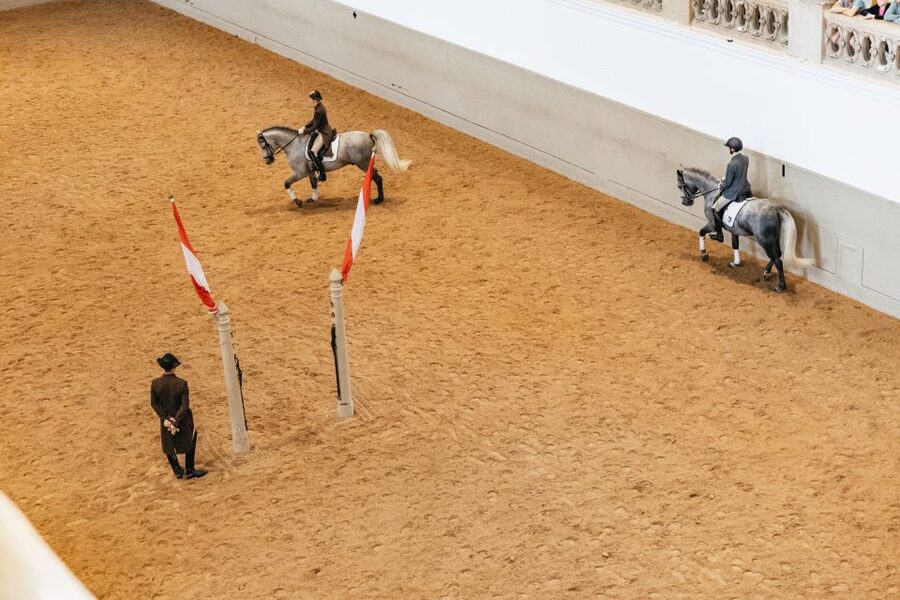
The exact program can change, but the morning exercise generally unfolds as a series of horse-and-rider groups entering the arena. You might see two sessions during the hour, with several horses working at one time.
At first, the horses may seem to be doing little more than walking or trotting around the arena. Give it a few minutes. The point is often to loosen the horse, settle its rhythm, and prepare its muscles before more focused work begins.
You may then see:
- Walking and trotting exercises
- Changes of lead
- Sidestepping and lateral work
- Lunging and groundwork
- Repetition of particular movements
- Rider instruction for less experienced teams
- Exercises that strengthen the muscles needed for haute école
The school jumps, including the levade, courbette, and capriole, are not part of every morning exercise. Seeing them is a matter of the day’s program and the horses’ training needs. I would book this session for the training process, not for a guarantee of airborne action.
One especially useful detail is the chance to compare teams. A younger horse may look less precise than an experienced stallion. A rider in training may wear a different uniform and riding hat, making the stages of instruction easier to identify. Watching those differences turns the hour into more than a display of beautiful animals.
The session is long enough to give you a clear sense of the work but short enough for most people who are curious rather than devoted to equestrian sport. For many families, the practice session is also easier to fit into a Vienna itinerary than a longer formal performance.
Why horse lovers get the most from it
If you ride, train horses, or follow dressage, this activity can be unusually rewarding. You will notice the small adjustments that a casual observer might miss: how a rider asks for a change, how a horse responds to pressure, and how repetition builds a movement.
The most interesting part may be watching instructors work with younger riders and less advanced horses. You are seeing education in progress, not only finished technique. That makes the session feel more open and human than a formal show, where every movement is presented at its best.
I also appreciate that the morning exercise shows the physical side of the school’s work. The horses need more than obedience. They need strength, balance, flexibility, and sound muscles. The training is designed to support the animals’ health and athletic ability, not simply to produce impressive tricks.
If you know little about horses, you can still enjoy the setting and the visual beauty. The riders’ control and the horses’ calm presence are easy to appreciate. But you may not always understand why one exercise matters more than another, particularly if the commentary is hard to hear from your seat.
A few more Vienna half-days to weigh up
- Vienna: Vivaldi’s Four Seasons Concert in Karlskirche
★ 4.7 · 14,951 reviews - Vienna: Skip-the-cashier-desk-line Giant Ferris Wheel Ride
★ 4.5 · 7,859 reviews - Vienna: Schönbrunn Palace & Gardens Skip-the-Line Tour
★ 4.7 · 7,739 reviews - Vienna: Light of Creation Votive Church Immersive Light Show
★ 4.8 · 6,779 reviews
Why non-riders should adjust expectations
You do not need equestrian knowledge to enjoy the visit, but you should choose it for the right reason. This is a behind-the-scenes look at practice, not a spectacle built around constant action.
The horses may spend much of the time moving in patterns that seem repetitive. That is normal. Training depends on repetition, and maintaining athleticism is one of the main goals. If you want nonstop rearing, jumping, and grand choreography, book an actual performance instead when one fits your schedule.
If formal performances are sold out, however, this is an excellent substitute. You still enter the same grand school and see the Lipizzaners working with their riders. At a much lower price, you get a useful glimpse of what happens before the polished presentation.
I would also recommend it to anyone interested in Vienna’s imperial past and grand interiors. The academy is not just a container for the horses. Its architecture, chandeliers, and ceremonial feel make the hour worthwhile even when the training remains basic.
Tickets, timing, and where to stand
The advertised price is $20 per person, which makes this one of the more affordable ways to see the Spanish Riding School. The value is strongest if you care about the horses or cannot obtain tickets for a performance.
Your voucher must be exchanged for a ticket at the entrance. Ticket pickup is available at the earliest one hour before the activity, so do not assume you can collect it several hours ahead of time. Build in enough time to find the entrance, exchange the voucher, and get into position.
Standing tickets are often the least expensive option. They can also provide a surprisingly good view if you find a clear place along the rail. But standing for the full hour may be uncomfortable, and leaning over a balcony edge can be tiring.
Seated tickets cost more, and the exact location matters. Some upper seats have limited legroom or a high wall that requires you to lean forward to see the arena properly. A seat is not automatically more comfortable than standing.
Arriving early is wise, particularly if you have a standing ticket or want a better view. The arena can feel crowded, and a position at one end may show one side of the action while hiding another.
Photography rules and the atmosphere
Photography and video recording are not allowed inside. Staff make repeated requests to keep mobile phones away, so plan to watch rather than document the session.
This rule may frustrate you, especially when a white stallion moves beautifully beneath the chandeliers. Still, you will enjoy the hour more if you accept the restriction before entering. Trying to take a quick photograph can also distract people around you and bring staff intervention.
The no-phone policy has one advantage: it keeps your attention on the riders’ hands, the horses’ rhythm, and the changing groups in the arena. You are there to observe a working session, and the atmosphere is better when the audience does that quietly.
The commentary can add useful context, but it is not always easy to hear. Upper-level seats seem to be the weakest choice if spoken information is a priority. Sit nearer the middle when possible, and treat the music and movement as the main part of the presentation.
Stairs, children, and accessibility
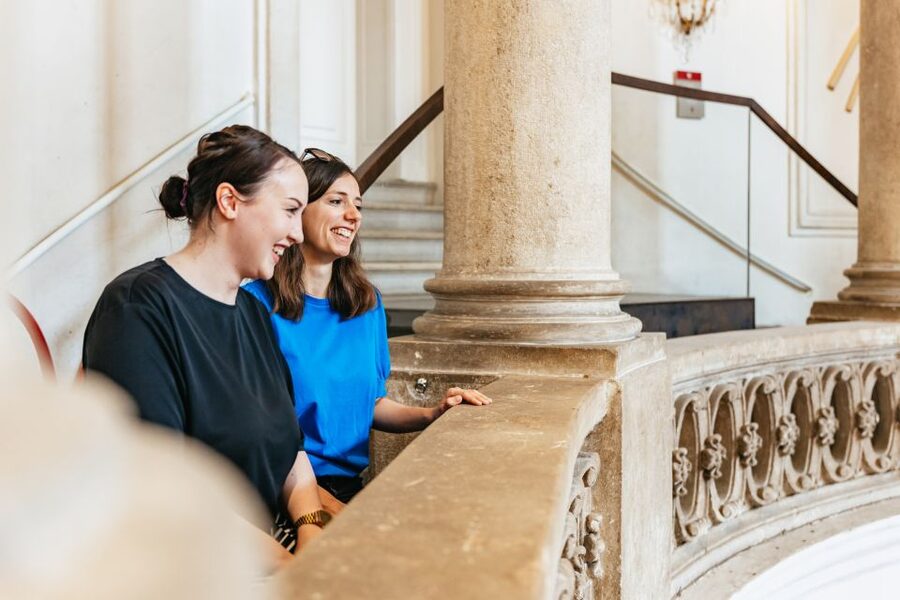
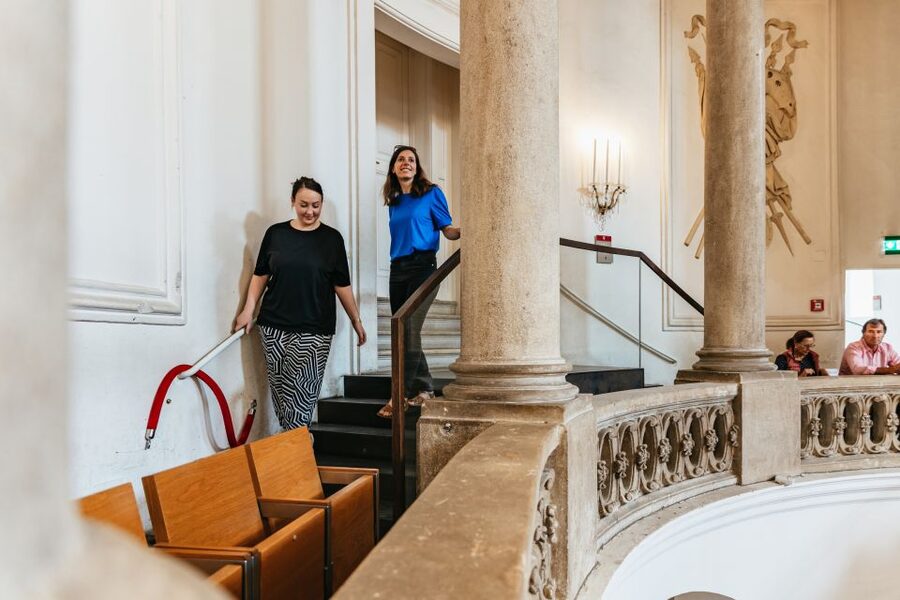
The building is protected as a historic monument and has no elevator. You should expect stairs, and the amount of climbing can be a serious issue for anyone with limited mobility.
Send an accessibility request in advance if you use a wheelchair or have difficulty walking. Do not rely on sorting it out at the door. A request is particularly important because some seating areas involve more stairs than expected.
Children aged 3 to 5 enter free but must sit on an adult’s lap. Children aged 6 to 18 receive discounted admission. Children under 3 are not admitted.
For families, the practice session can be a good choice because it costs less than a performance and lasts one hour. Very young children may find the repetitive sections slow, while older children can enjoy spotting the different rider levels and horse movements.
Pets are not allowed. Hotel pickup and drop-off are not included, so you make your own way to the Spanish Riding School entrance.
Who should book this experience
I would choose the morning exercise for:
- Horse lovers and riders
- Visitors interested in dressage training
- Anyone unable to get performance tickets
- Families seeking a reasonably priced Vienna activity
- Architecture fans who want to see the Winter Riding Academy
- Curious visitors who enjoy watching skilled work in progress
I would think twice if your main goal is to see all the famous jumps. They may not be practiced during your session, and there is no promise that a particular horse or movement will appear.
I would also be cautious if you cannot stand for an hour or manage stairs. Contact the school before booking, and pay close attention to the seating type. A cheaper ticket is not a bargain if it leaves you uncomfortable throughout the session.
Is the $20 ticket worth it?
For an hour inside one of Vienna’s most memorable historic interiors, $20 is a fair price. You are paying for the setting, the Lipizzaners, the riders’ skill, the music, and a close look at the work behind a famous performance tradition.
The value drops only if you expect a full show. Basic exercises can occupy much of the session, and advanced movements are not guaranteed. I would describe it as a training demonstration with musical accompaniment, not a performance at a discount.
That distinction makes the decision easy. If you want the arena and the horses at a modest cost, book it. If you want a carefully staged sequence of spectacular movements, save your money for a formal performance instead.
FAQ
How long does the Spanish Riding School training last?
The training session lasts one hour.
How much does the training cost?
The listed price is $20 per person.
What can I see during the morning exercise?
You can see Lipizzaner stallions and their riders practice relaxation exercises, dressage movements, muscle-building work, and movement refinement. The levade, courbette, and capriole may sometimes appear, but they are not practiced every day.
Is the training held inside?
Yes. The session takes place in Vienna’s Baroque Winter Riding Academy.
Is music included?
Yes. The morning exercise is accompanied by classical Viennese music.
Can I take photos or record video?
No. Photography and video recording are not allowed inside.
Are children admitted?
Children aged 3 to 5 enter free but must sit on an adult’s lap. Children aged 6 to 18 receive discounted admission. Children under 3 are not admitted.
Is the building accessible by elevator?
No. Due to monument protection, there is no elevator. Wheelchair users and people with walking difficulties should send an accessibility request in advance.
Recently added around Vienna
- Vienna: Private tour Mauthausen and Linz★ 4.1 · 3 reviews
- 2-Day Prague Tour from Vienna with private Transfers and Lunches★ 5.0 · 3 reviews
- Vienna Self Guided Sherlock Holmes Murder Mystery Game★ 4.5 · 3 reviews
- Vienna Private Schönbrunn Palace Tour, Extra Rooms and Gardens★ 5.0 · 3 reviews
- Salzburg and Lake Region Private Day Trip from Vienna★ 5.0 · 3 reviews
- Small-group Vienna Wine Tour★ 5.0 · 3 reviews
- True Crime mobile puzzle rally Vienna★ 4.0 · 3 reviews
- Exploring the Gutenstein Alps★ 5.0 · 3 reviews
Spanish Riding School Tickets, compared.
Spanish Riding School 45-Minute Performance Show
Read our review →
Spanish Riding School Guided Architectural Tour
Read our review →Browse the lists this tour appears in