
Reviewed · WALKING TOURS IN VIENNA
Private Jewish Vienna Walking Tour
Jewish Vienna is best understood outdoors, where missing buildings, guarded synagogues, and memorials reveal what the city tried to erase. This private three-hour walk links the Stadttempel, the former Jewish quarter of Leopoldstadt, and the powerful Holocaust memorial at Judenplatz.
I like the private format, which lets your guide adjust the pace and explain difficult subjects without rushing a large group. I also like the use of historian guides, including guides such as Annalie and Elizabet, who bring photographs, videos, and personal interpretation to the streets.
The main caution is guide quality. One booking fell short because the guide lacked enough Jewish Vienna background, and the operator admitted that its vetting had failed in that case. This is an important subject, so I would confirm the guide’s specialty before booking.
Key points to know before you book
- The tour covers four important sites: the Stadttempel, Theater Nestroyhof Hamakom, Leopoldstadt, and Judenplatz.
- You receive a private guide for your group only, with a maximum of 10 people.
- Central hotel or apartment pickup is available, though public transport may be needed.
- The Stadttempel interior is not included, so arrange a separate synagogue visit if you want to go inside.
- The price is $564.75 per group, which becomes more reasonable with several people sharing the cost.
- The subject moves from medieval Jewish settlement to Nazi persecution and today’s community, giving the walk a broad historical frame.
Why Jewish Vienna makes a strong walking tour
Vienna’s Jewish story is not confined to one museum or one memorial. It is spread through central streets, old commercial districts, theater buildings, vanished synagogues, and sites where only a few columns or stones remain.
That makes a guided walk especially useful. You can pass a handsome building and miss its Jewish connection entirely. A historian can point out what is absent, explain why a synagogue was hidden behind an ordinary street façade, and connect a local address to the wider political life of Vienna.
The subject reaches back to the Middle Ages, when Jewish settlement grew despite repeated expulsions. It then moves into the modern era, when Jewish residents helped shape business, public life, scholarship, music, and theater. Finally, the route confronts Nazi persecution, destroyed synagogues, and the people who were killed or survived.
I appreciate that the tour does not treat Jewish Vienna as a closed chapter. The experience also considers the modern community and the continuing problem of antisemitism in Europe.
This is not a cheerful sightseeing stroll in the usual sense. Some stops are quiet and painful. But the three-hour format gives you enough time to understand the places without turning the day into an exhausting full-history lecture.
More Walking Tours in Vienna
- Vienna: Guided Walking Tour of City Center Highlights
★ 4.7 · 4,989 reviews - Vienna: Vienna Central Cemetery Guided Walking Tour
★ 4.8 · 3,307 reviews - Vienna: Guided Walking Tour of City Highlights & Hidden Gems
★ 4.9 · 2,180 reviews
Beginning at the Jewish City Temple
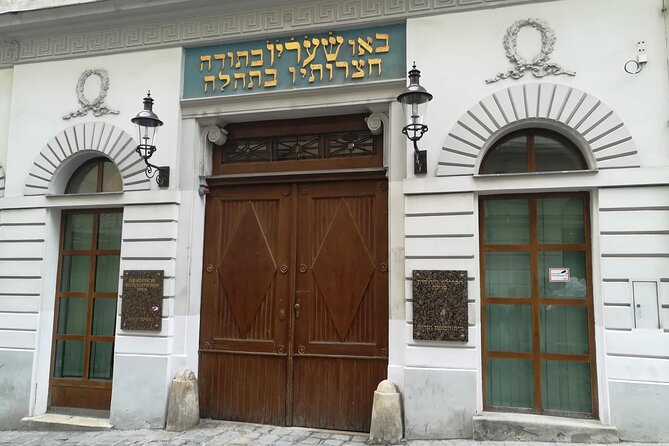
The usual starting point is the Jewish City Temple, also called the Stadttempel, at Seitenstettengasse 4 in Vienna’s first district. If you choose hotel or apartment pickup, the guide can meet you centrally and lead you to the first site.
Outside the temple, you learn why one of Vienna’s most important synagogues has such a restrained street presence. For centuries, Jewish communities faced restrictions that affected where and how they could build. Even when Jewish residents played a major role in the city’s growth, their houses of worship often had to remain difficult to identify from the street.
That contrast is one of the walk’s strongest ideas: influence and visibility did not always go together. The temple’s beautiful doors invite attention, but the building’s outward appearance also tells you something about the limits placed on Jewish life.
The tour does not include entry to the Stadttempel. This is a real limitation if you hope to see the sanctuary. You can arrange a separate guided visit through the synagogue, with tours offered from April through October, Monday through Thursday.
The timing can work nicely. A Monday 11:30 a.m. synagogue visit can be followed by lunch and a 2 p.m. Jewish Vienna walk. On Tuesday or Thursday, a 2 p.m. synagogue tour can follow this experience’s 9:30 a.m. start. Those visiting hours are useful to know before you set your Vienna schedule.
Theater Nestroyhof and Jewish cultural life
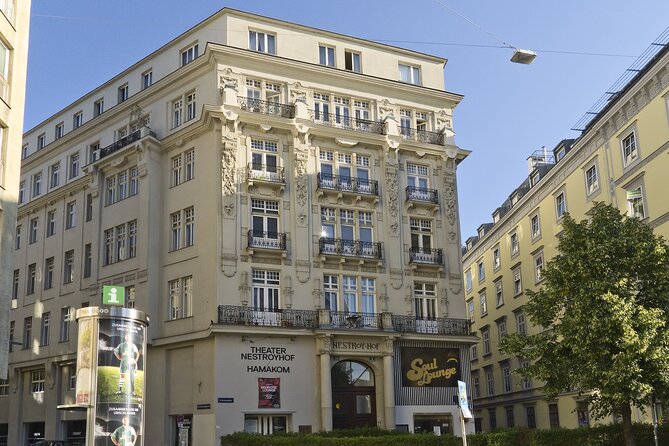
From religious life, the walk turns toward culture at Theater Nestroyhof Hamakom. The building’s Art Nouveau exterior is worth a close look, but the important story is what took place behind it.
The theater was once home to Yiddish-speaking ensembles. That detail opens a wider discussion about the modern Jewish community’s role in Vienna’s cultural life. Jewish influence was not limited to synagogues or religious institutions. It reached into theater, music, publishing, business, and public conversation.
You view the theater from outside, so this stop is brief and architectural rather than an interior performance visit. Still, the building gives the guide a useful place to explain how Jewish culture shaped the city before the destruction of the 1930s and 1940s.
I would pay close attention here to the connections your guide makes between the building and the people who used it. The value is less in looking at a façade than in understanding what a Yiddish theater says about language, identity, and the place of Jewish residents in Vienna.
Leopoldstadt and the four white columns
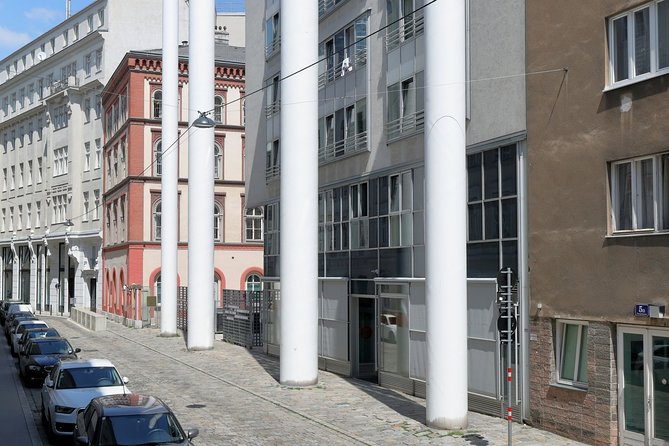
The route continues into Leopoldstadt, Vienna’s second district. This area became closely linked with Jewish life, and the walk brings you to the memorial site of the destroyed Leopoldstädter Temple.
The synagogue itself is gone. In its place, four tall white columns reach upward. Their simplicity is effective. You do not see a reconstructed building pretending that the past can be restored. You see a marked absence.
This is where a private guide can help you read the site without rushing. The columns point toward a congregation, a neighborhood, and a vanished institution, but they do not explain all of that on their own. Your guide places the temple within the story of Jewish settlement, growth, persecution, and destruction.
The route through Leopoldstadt may include cobblestones and uneven streets. One booking included a participant using a scooter, with the guide helping the group move between sites by underground train and on foot. If mobility is a concern, tell the operator in advance and ask how the route can be handled on your date.
Public transport is part of the practical plan. Metro or tram tickets are not included, but the guide can help you buy them at the first station if you do not have a Vienna Pass or another valid pass.
A different way to spend an afternoon here:
- Vienna: Vivaldi’s Four Seasons Concert in Karlskirche
★ 4.7 · 14,951 reviews - Vienna: Spanish Riding School Training
★ 3.9 · 9,281 reviews - Vienna: Skip-the-cashier-desk-line Giant Ferris Wheel Ride
★ 4.5 · 7,859 reviews - Vienna: Schönbrunn Palace & Gardens Skip-the-Line Tour
★ 4.7 · 7,739 reviews
Judenplatz and the memorial to murdered Jews
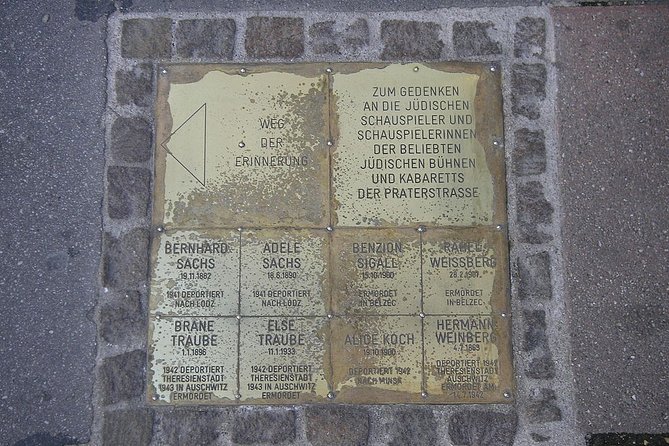
The most emotionally powerful part of the walk comes at Judenplatz. Here, the tour considers the victims and survivors of Nazi genocide, along with the longer history of antisemitism in Europe.
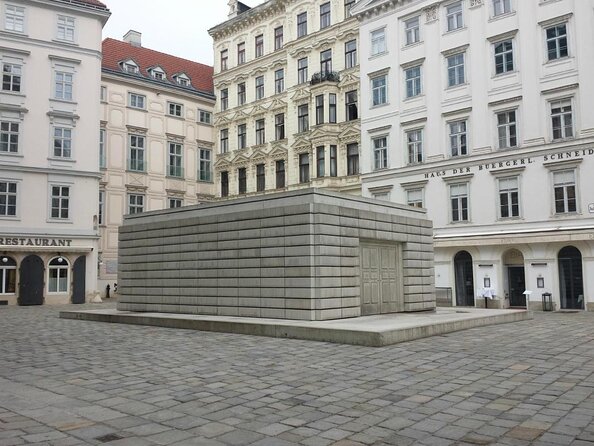
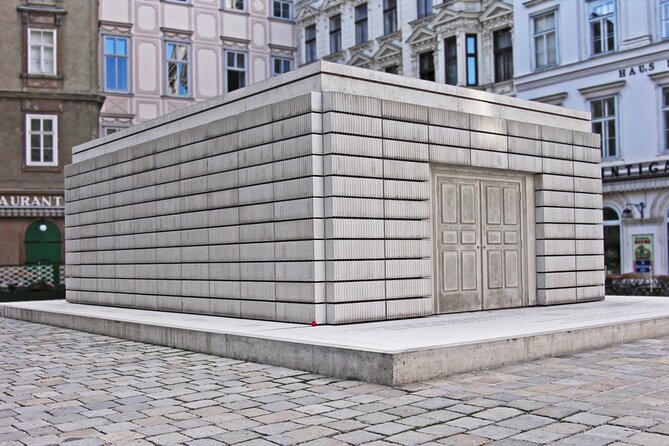
The square includes the memorial to Austrian Jewish victims of the Shoah, often described as a library with its books turned inward. The closed shelves suggest lives that can no longer be read, continued, or recorded by the people who were killed.
The memorial is especially moving because it avoids a heroic pose. It does not show a famous leader or a dramatic historical scene. Instead, it presents a sealed body of books, each one standing for a life and a story that will never be completed.
Judenplatz also connects to the remains of destroyed synagogues associated with Ashkenazi and Sephardic congregations. The square therefore brings several layers together: medieval Jewish life, religious communities, Nazi destruction, and the challenge of remembering people as individuals rather than as a statistic.
Expect this stop to slow the pace. It should. A good guide will give you room to look, then explain the site without filling every silence.
What the historian guide adds
The company uses professors, doctoral students, historians, journalists, art critics, and published authors as guides. That range can produce a strong experience, especially when the guide has a clear specialty in Jewish Vienna.
Past guide names connected with this experience include Annalie and Elizabet. Annalie’s tour included an overview at the hotel, public transport to the sites, early Jewish settlement, the accomplishments of Jewish residents and their families, Kristallnacht, the Holocaust, and modern Vienna. Elizabet has been associated with a tour that used photographs and videos to explain the historical importance of each stop.
Those details matter because this tour depends heavily on interpretation. Much of the route is made up of exteriors, memorials, and places where the original buildings no longer exist. Strong preparation turns a few columns or a plain street view into something legible.
At the same time, I would not assume that every guide has the same level of Jewish history training simply because the guides have impressive academic or professional backgrounds. The operator acknowledged one case in which a new team member knew Vienna well but was not sufficiently prepared for this specific subject.
Before confirming, ask who will lead your tour and what their background is in Jewish Vienna, the Holocaust, and modern Jewish life. That small step can protect the quality of an experience dealing with material this important.
How the private format affects the experience
The tour is private for your group, with up to 10 people. That gives you more control than a standard group walk. You can ask detailed questions, pause at a memorial, or request a slower pace without holding up strangers.
The format is also useful for families or mixed-age groups. You can ask the guide to explain a complicated point in simpler terms, or spend more time on the topics that matter most to your group.
A private tour does cost more upfront. At $564.75 per group, the price is high for one or two people. Split among 10 people, it works out to about $56.48 per person before transport costs. For four people, it is about $141.19 each, and for two, about $282.38 each.
I see the best value for a family group, a group of friends, or several relatives traveling together. You are paying for a dedicated historian rather than a seat on a large walk, and the subject benefits from time for questions.
The price does not include metro or tram fares. Those costs are small compared with the tour fee, but remember to carry a valid Vienna transport pass or budget for tickets.
Timing, pickup, and planning your day
The walk lasts about three hours. Pickup is offered from a central hotel or flat, which is convenient if you want to begin without finding a meeting point. If needed, the guide leads you by public transport to the sites.
You can also meet at the Jewish City Temple. That option makes sense if you are already in the first district or have arranged a separate visit to the synagogue.
The tour is offered in English, and confirmation arrives when you book. Most people can participate, but this is a walking tour with public transport and some uneven streets, so explain any mobility needs before the day begins.
I would place this experience early in your Vienna stay if Jewish history is a major reason for your visit. The guide can help you understand later visits to museums, memorials, and historic neighborhoods. If you plan to visit the synagogue interior, coordinate the opening days and tour times first, then fit this walk around that appointment.
Free cancellation is available up to 24 hours before the local start time. Changes or cancellations inside that window are not refunded.
Who will get the most from this experience
I recommend the tour most strongly to you if you want historical context rather than a quick list of addresses. It suits people who want to understand how Jewish life developed in Vienna, how Jewish residents shaped the city, and how persecution changed its streets.
It is also a good choice if you prefer conversation to a museum audio guide. The private setup gives you a chance to ask about family history, religious communities, architecture, antisemitism, Kristallnacht, or the modern Jewish community.
You may find it less satisfying if you mainly want interiors. The Stadttempel, theater, and other locations are viewed from outside, and the destroyed synagogues are represented by memorials rather than standing buildings.
It may also be too heavy for children who are not ready for Holocaust history. The guide can likely adjust the discussion, but the core of the tour includes genocide and destroyed communities, so plan accordingly.
Should you book Jewish Vienna with a private guide?
Book it if you value a specialist guide, want a private pace, and are prepared for a serious three hours. The route is well chosen: the Stadttempel introduces religious life, Nestroyhof adds culture, Leopoldstadt shows the physical loss of a synagogue, and Judenplatz brings the story to its most painful point.
I would book with one condition: confirm the guide’s Jewish Vienna background. The strongest experiences have included careful preparation, visual material, and clear historical interpretation. The one serious weakness reported for this experience was not the route, but a mismatch between the guide’s general Vienna skills and the subject’s demands.
For a group of several people, the price can be fair for a private historian-led walk. For one or two people, it is a costly choice, but perhaps worthwhile if this is a central part of your Vienna visit. If you want the synagogue interior, arrange that separately and use this tour for the broader story of Jewish Vienna.
FAQ
How long does the private Jewish Vienna tour last?
The tour lasts approximately three hours.
How many people can join the private tour?
The private tour is for your group only and can include up to 10 people.
Is hotel pickup available?
Yes. Pickup is offered from a central hotel or flat. You can also meet at the Jewish City Temple at Seitenstettengasse 4 in Vienna’s first district.
Is transportation included?
Metro or tram fares are not included. If you do not have a Vienna Pass or another visitor pass, the guide helps you purchase tickets at the first station.
Does the tour enter the Jewish City Temple?
No. The tour visits the temple exterior. Separate synagogue tours can be arranged directly with the synagogue from April through October, Monday through Thursday.
What language is the tour offered in?
The tour is offered in English.
Can I cancel for a full refund?
Yes. You can cancel at least 24 hours before the experience start time for a full refund. Cancellations or changes made less than 24 hours before the start time are not refunded.
Recently added around Vienna
- Vienna: Private tour Mauthausen and Linz★ 4.1 · 3 reviews
- 2-Day Prague Tour from Vienna with private Transfers and Lunches★ 5.0 · 3 reviews
- Vienna Self Guided Sherlock Holmes Murder Mystery Game★ 4.5 · 3 reviews
- Vienna Private Schönbrunn Palace Tour, Extra Rooms and Gardens★ 5.0 · 3 reviews
- Salzburg and Lake Region Private Day Trip from Vienna★ 5.0 · 3 reviews
- Small-group Vienna Wine Tour★ 5.0 · 3 reviews
- True Crime mobile puzzle rally Vienna★ 4.0 · 3 reviews
- Vienna: Wachau Valley Private Kayak and Wine Tour★ 5.0 · 3 reviews
Walking Tours in Vienna, compared.

Guided Walking Tour of City Center Highlights
Read our review →
Guided Walking Tour of City Highlights & Hidden Gems
Read our review →
Vienna Historic Center Small Group Walking Tour
Read our review →


Ghosts and Legends Guided Nighttime Walking Tour
Read our review →

Browse the lists this tour appears in