
Reviewed · WALKING TOURS IN VIENNA
Private Introduction to Vienna Walking Tour
Vienna’s past comes in layers, and this private walk lets you read those layers right in the streets. You move from the Habsburg court at the Hofburg to imperial burial customs, Ottoman sieges, Nazi-era liberation, and modern Austria in one well-shaped three-hour route. The best part is the historical range.
I like the personal format, with only your group and a private historian guide. I also like the route’s variety: grand palaces and cathedrals share the stage with old wall remnants, the Loos House, Naschmarkt, and the MuseumsQuartier. The main consideration is the price, $566.25 for up to 10 people, which makes sense for a full group but can feel steep for one or two guests.
Key points to know before booking
- A private three-hour orientation: You get a focused introduction to central Vienna without sharing the guide with strangers.
- A route packed with contrasts: The walk links Hofburg power, Baroque churches, modern architecture, war memorials, markets, and museums.
- Historian-led storytelling: Guides including Else, Katarina, Selin, and Biljana are praised for warmth, clear explanations, customization, and a comfortable pace.
- Three unusual Habsburg burial traditions: See where imperial hearts, entrails, and bodies were placed in separate churches.
- A useful first-day choice: The tour gives you a city framework before you return on your own to museums and interiors.
- Good value for a larger party: The flat group price covers up to 10 people, though the math is less attractive for a couple.
A smart first look at Vienna’s many pasts
I like this tour because it does not treat Vienna as only a city of waltzes, palaces, and coffeehouses. Its route shows how royal power, religion, military danger, architecture, trade, and present-day culture all occupy the same compact center.
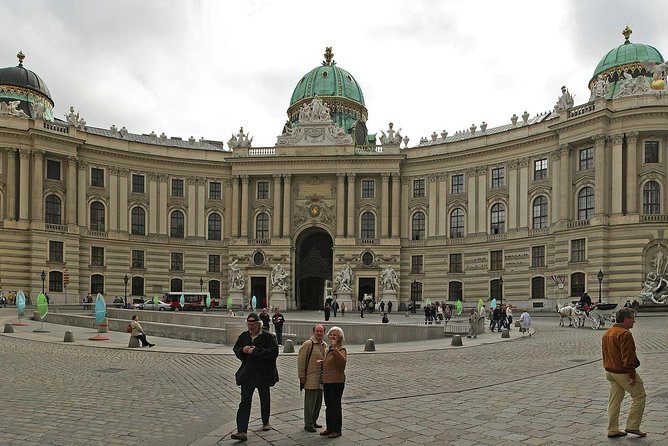
You begin at Michaelerplatz, beside the Hofburg, the Habsburg imperial palace and seat of power since the thirteenth century. That gives your guide a strong opening point. You are not simply looking at a grand façade. You are standing at the former center of an empire that shaped much of Central Europe.
The private setup matters here. A guide can pause when your group has a question, adjust the amount of detail, or move faster if everyone is eager to keep going. The strongest praise for the guides focuses on exactly this quality. Else was described as energetic and efficient without making the walk feel rushed. Biljana received similar praise for a good pace and storytelling that worked for adults in their twenties as well as older family members.
More Walking Tours in Vienna
- Vienna: Guided Walking Tour of City Center Highlights
★ 4.7 · 4,989 reviews - Vienna: Vienna Central Cemetery Guided Walking Tour
★ 4.8 · 3,307 reviews - Vienna: Guided Walking Tour of City Highlights & Hidden Gems
★ 4.9 · 2,180 reviews
Michaelerplatz and the Hofburg’s imperial stage
Michaelerplatz is an excellent place to begin because it puts several versions of Vienna in one view. The Hofburg dominates the square, while the green and gray Loos House provides a sharp modern contrast.
Adolf Loos designed the Loos House in the early twentieth century. Its plain exterior caused a stir beside the ornate imperial surroundings. Your guide can use that contrast to explain that Vienna was not frozen in its Habsburg past. The city also became a center of modern architecture and new ideas.
The Hofburg itself is one of the tour’s major visual anchors. The palace served as the Habsburgs’ seat of power for centuries, and its scale helps you understand the reach of the dynasty. This portion is especially useful if you plan to visit palace interiors later. You will already have a basic sense of the political role the buildings played.
The tour is a walking history experience, not an advertised interior tour. Do not book it expecting extended time inside the Hofburg or other landmarks. Its value comes from seeing the buildings in their urban setting and having someone explain how the pieces fit together.
Kohlmarkt, the Graben, and the city’s grand center
From Michaelerplatz, the route follows Kohlmarkt and the Graben. Today these are fashionable shopping streets, but the buildings and monuments reveal older layers beneath the polished storefronts.
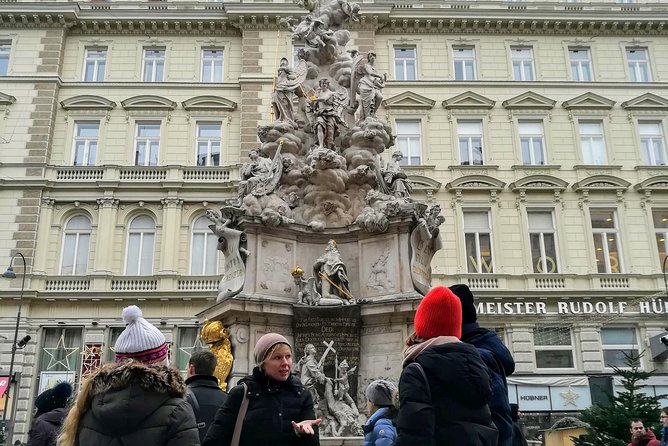
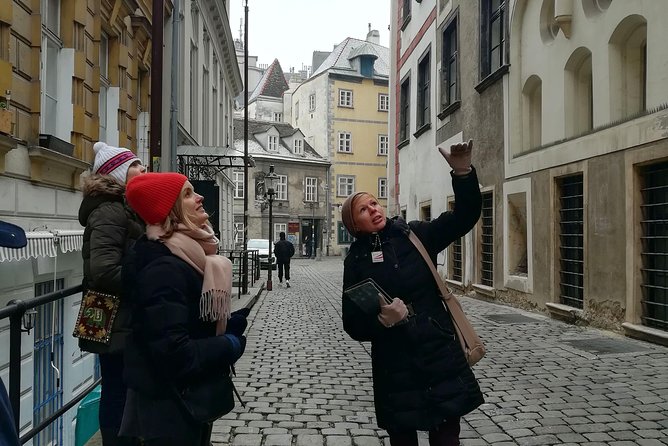
The Graben offers plenty for a guide to unpack. You will see the plague column, a major Baroque church, and grand buildings in several architectural styles. This is the sort of street where looking upward pays off. A private guide can point out details you might pass without noticing while you keep moving through the city center.
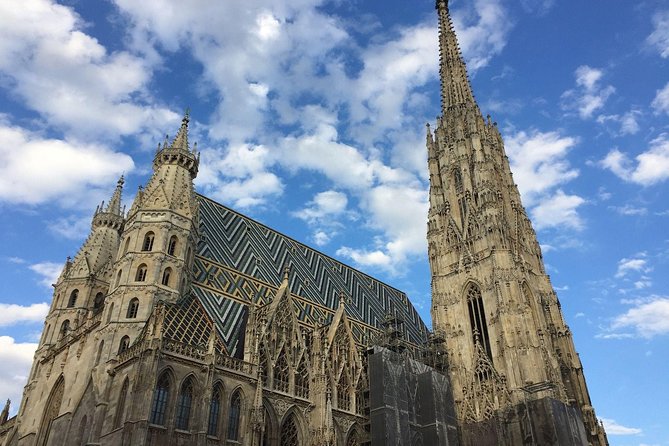
The route leads toward Stephansdom, Vienna’s national architectural icon. St. Stephen’s Cathedral is not just a postcard stop. It also introduces one of the tour’s most memorable themes, the Habsburg practice of placing different parts of the body in different sacred locations.
At St. Stephen’s, the imperial entrails were traditionally kept. Nearby, the Capuchin Church contains the sarcophagi of many Habsburg rulers. St. Augustine’s Church holds silver urns containing their hearts. The arrangement may sound strange to modern ears, but it gives you a clear glimpse of how the dynasty connected death, religion, ceremony, and royal identity.
This is one of the tour’s most distinctive details. Many city walks mention the Habsburgs in broad terms. This one gives you a concrete and memorable way to understand them.
Habsburg burial customs and the power of ceremony
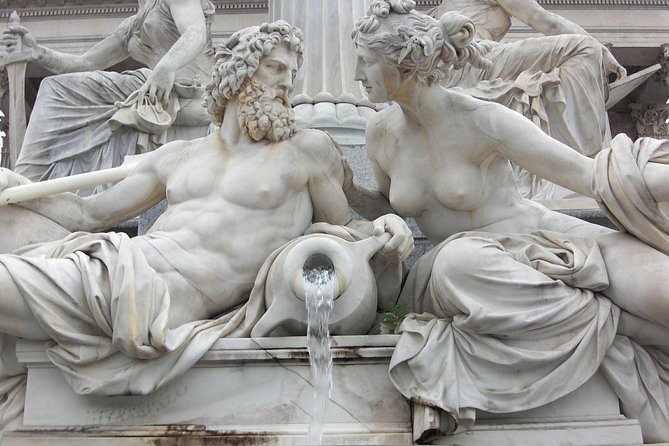
The three burial sites also show how close Vienna’s major attractions are to one another. The route does not require a long transfer from one district to the next. Instead, you walk through the city and watch the story change from public ceremony to private devotion.
The Capuchin Church is associated with the bodies of the rulers, while St. Augustine’s Church is tied to the hearts. Stephansdom completes the unusual tripartite tradition with the entrails. Your guide can give this subject the weight it deserves without turning the walk into a list of dates and names.
This section may appeal most to you if you enjoy political and religious history. If you prefer only art or architecture, the burial customs may feel like a detour. Still, they are exactly the kind of detail that makes a city more memorable after you leave.
Because the tour lasts about three hours, you should expect an overview rather than a long visit at each church. The schedule has many stops, and the guide’s job is to connect them rather than provide a full guided visit inside every building.
A different way to spend an afternoon here:
- Vienna: Vivaldi’s Four Seasons Concert in Karlskirche
★ 4.7 · 14,951 reviews - Vienna: Spanish Riding School Training
★ 3.9 · 9,281 reviews - Vienna: Skip-the-cashier-desk-line Giant Ferris Wheel Ride
★ 4.5 · 7,859 reviews - Vienna: Schönbrunn Palace & Gardens Skip-the-Line Tour
★ 4.7 · 7,739 reviews
From medieval walls to the Ringstrasse
Along the edge of the inner city, you examine remains of the old city walls. These defenses date to the twelfth century and helped protect Vienna during Ottoman sieges in 1529 and 1683.
The walls eventually came down, making room for the Ringstrasse. Vienna’s grand circular boulevard was the city’s answer to the broad boulevards being built in Paris. This change tells you a great deal about Vienna’s ambitions. The city moved from medieval defenses to imperial display and modern urban planning.
The contrast is easy to miss if you only ride around the Ringstrasse or photograph its monumental buildings. On foot, the guide can show you how the old and new city meet. You also get a better sense of how the historic center was reshaped rather than simply preserved.
This part of the walk is a good reminder that Vienna’s beauty is not accidental. Its streets reflect military threats, imperial confidence, changing technology, and nineteenth-century civic planning.
Schwarzenbergplatz and twentieth-century Vienna
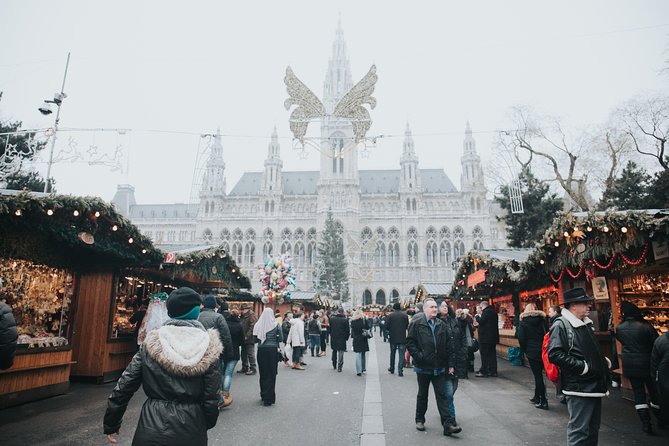
The route continues to Schwarzenbergplatz, where a large fountain and memorial honor Soviet soldiers who died liberating Vienna from the Nazis. The memorial remains a politically charged reminder of the city’s twentieth-century past.
This stop broadens the tour beyond the Habsburg era. Vienna is not only about emperors and Baroque churches. The city also carries the memory of Nazi rule, war, liberation, and postwar occupation.
The surrounding area is associated with many embassies, adding another layer of political history. A private historian guide can explain the setting in a way that connects the monument to Austria’s more recent position in Europe.
This may be a serious moment in an otherwise scenic walk, and that is a strength. A good city introduction should not smooth away difficult history. It should give you enough context to understand what you are seeing.
Belvedere, Karlsplatz, and the Naschmarkt view

The walk makes a quick detour toward Belvedere Palace before heading back toward Karlsplatz. The tour information does not promise admission to the palace, so think of this as an exterior and city-orientation stop rather than a museum visit.
Belvedere is an important addition because it takes you beyond the tightest part of the old center. It also gives the route a change of scale. After the dense streets around the Hofburg, Graben, and Stephansdom, the palace setting helps you see Vienna as a larger imperial capital.
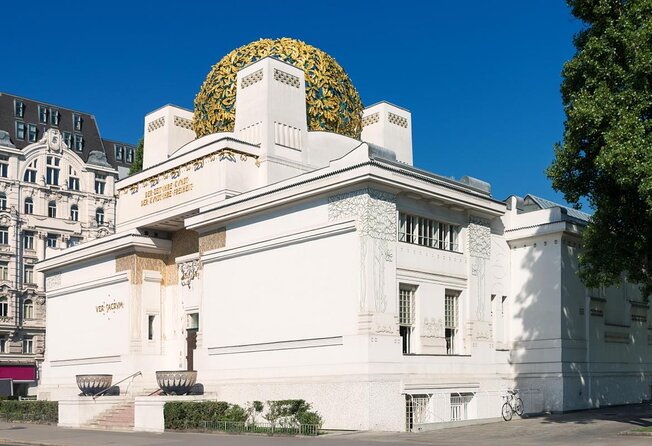
Back toward Karlsplatz, you get a view of the gold-domed Secession building and the Naschmarkt. The Secession building represents Vienna’s turn toward modern art and architecture, while Naschmarkt brings in food, commerce, and daily city life.
Food and drinks are not included, so do not assume this portion includes a market tasting or a scheduled meal. You can use the guide’s local knowledge after the walk, though. One couple specifically noted that they found a good Italian trattoria after receiving help with their plans. That is a small but useful benefit of having a local guide at the start of your stay.
MuseumsQuartier and Maria Theresien Platz
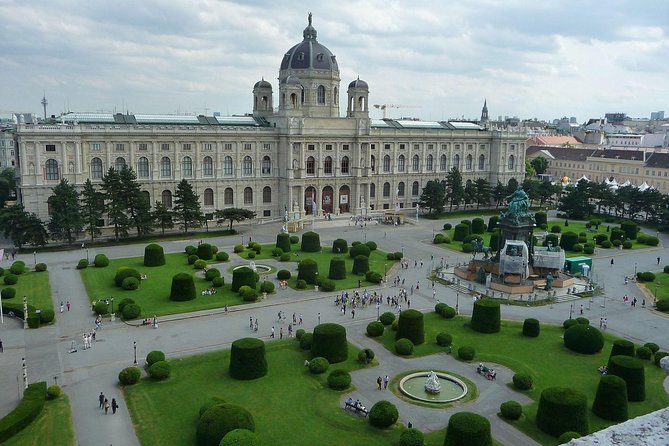
The final stretch runs through the MuseumsQuartier and Maria Theresien Platz. This is Vienna’s strongest concentration of major museums, so it is a practical area to understand before planning the rest of your visit.
A guide can help you decide which cultural sites match your interests, even though admission to museums is not part of the three-hour walk. The setting also lets the conversation move from imperial Austria to the capital’s present-day cultural, political, and economic direction.
That final shift is important. You finish with more than a collection of royal buildings. You get a basic picture of how Vienna works as a modern capital, a cultural center, and a city still shaped by its imperial past.
For a first morning, this ending makes sense. You can spend the rest of your trip returning to the places that caught your attention. The walk gives you a framework, then leaves the detailed museum visits for you to handle at your own pace.
What the private guide changes
The tour is offered in English and is led by an historian guide. Names associated with the experience include Katarina, Selin, Biljana, and Else. The individual guide assigned to your booking may differ, but the guide makes a major difference to the feel of the walk.
The most praised qualities are warmth, storytelling, personal attention, and pace. Selin was praised for creating a customized route for a family and for combining major sights with lesser-known details. Biljana was praised for keeping a group of young adults interested. Else was noted for meeting a couple at their hotel, moving efficiently, and covering a lot without making them feel hurried.
Those details tell you what to request when booking or confirming: explain your group’s ages, interests, and preferred pace. The format allows room for that kind of adjustment, though the exact route and timing can depend on your guide and starting arrangements.
A private tour also works well for families who want to ask questions without holding up a larger group. It is less ideal if you prefer a loose, inexpensive walk where you can wander without a set historical focus.
Price, group size, and practical value
The price is $566.25 per group of up to 10 people. For a full group, that works out to about $57 per person. For five people, it is roughly $113 each. For two people, the cost is about $283 per person, so the value depends heavily on your party size.
You are paying for a private three-hour walk with a historian guide, not for food, drinks, or attraction admission. That price can be reasonable if you want a tailored introduction and plan to use the information for the rest of your stay. It is harder to justify if you mainly want to enter the Hofburg, Belvedere, or museums, since those visits are not included.
Pickup is offered if arranged in advance. Otherwise, meet the guide 15 minutes before the start at Cafe Hawelka, Dorotheergasse 6, 1010 Vienna. The starting point is central and easy to build into a first day in Vienna, but wear comfortable shoes. The itinerary covers a lot of ground and includes historic streets, squares, and city boulevards.
Confirmation arrives at booking. Free cancellation is available up to 24 hours before the start time. Changes or cancellations inside that window are not accepted for a refund.
Who should book this Vienna walk?
I would choose this tour for a family, small group of friends, or couple who wants a serious but approachable city introduction. It is especially useful on your first full day, when you need to learn the layout before deciding where to spend more time.
History fans will appreciate the connection between the Habsburg dynasty, Ottoman sieges, the Ringstrasse, twentieth-century war history, and present-day Austria. Architecture fans get Loos, Baroque churches, Stephansdom, the Secession building, imperial monuments, and the MuseumsQuartier.
Families may find the private format worth the extra cost because the guide can adjust the pace and answer questions directly. The experience also suits groups with older children and young adults, with Biljana’s reported success across a 20 to 25 age range offering a useful sign that the storytelling is not aimed only at specialists.
I would look elsewhere if you want extensive interior visits, a food tour, or a low-cost group experience. This is a city orientation with historical interpretation, not a museum package or culinary outing.
Should you book the Private Introduction to Vienna Walking Tour?
Book it if you want Vienna explained by a person rather than simply viewed from a map. The route covers a remarkable range in three hours, and the private format gives you a better chance of setting the pace and asking the questions that matter to your group.
The strongest reason to book is the guide relationship. The experience has received full recommendation from all 25 ratings provided, with particular praise for Else, Katarina, Selin, and Biljana for their personal approach, storytelling, and calm handling of a busy sightseeing route.
The main decision is the price. A group of eight to ten can get good value from the flat rate. A couple should book only if a private historian-led introduction is more important than keeping costs low.
FAQ
How long is the Private Introduction to Vienna Walking Tour?
The walking tour lasts approximately three hours.
How much does the tour cost?
The listed price is $566.25 per group, with up to 10 people included.
Is this a private tour?
Yes. Only your group participates in the activity.
What language is the tour offered in?
The tour is offered in English.
Where does the tour begin?
Unless hotel pickup has been arranged, meet at Cafe Hawelka, Dorotheergasse 6, 1010 Vienna, Austria.
How early should I arrive?
You should meet your guide 15 minutes before the scheduled start time.
Is hotel pickup available?
Pickup is offered if it has been arranged in advance.
Are food and drinks included?
No. Food and drinks are not included unless specifically stated.
Can I cancel for a full refund?
Yes, if you cancel at least 24 hours before the experience starts. Cancellations or changes made less than 24 hours before the start time are not accepted for a refund.
Recently added around Vienna
- Vienna: Private tour Mauthausen and Linz★ 4.1 · 3 reviews
- 2-Day Prague Tour from Vienna with private Transfers and Lunches★ 5.0 · 3 reviews
- Vienna Self Guided Sherlock Holmes Murder Mystery Game★ 4.5 · 3 reviews
- Vienna Private Schönbrunn Palace Tour, Extra Rooms and Gardens★ 5.0 · 3 reviews
- Small-group Vienna Wine Tour★ 5.0 · 3 reviews
- Salzburg and Lake Region Private Day Trip from Vienna★ 5.0 · 3 reviews
- True Crime mobile puzzle rally Vienna★ 4.0 · 3 reviews
- Exploring the Gutenstein Alps★ 5.0 · 3 reviews
Walking Tours in Vienna, compared.

Guided Walking Tour of City Center Highlights
Read our review →
Guided Walking Tour of City Highlights & Hidden Gems
Read our review →
Vienna Historic Center Small Group Walking Tour
Read our review →


Ghosts and Legends Guided Nighttime Walking Tour
Read our review →

Browse the lists this tour appears in