
Reviewed · SCHONBRUNN PALACE TOURS
Skip the Line:Imperial Carriage Museum by Schönbrunn Kaiserliche Wagenburg Wien
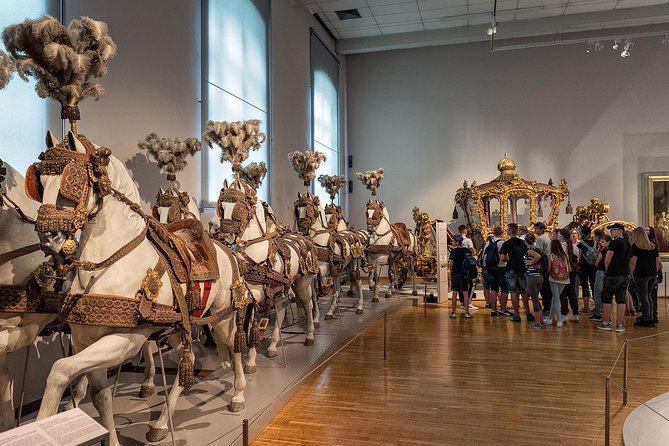
The most memorable thing here is the sheer size and ceremony of the Habsburg vehicles. The Baroque Imperial Coach is the star, but the black hearse, children’s carriages, coronation coaches, and everyday travel vehicles make royal life feel surprisingly tangible.
I like the museum for two clear reasons: you get close to rare objects without the crush of Schönbrunn Palace, and the Sisi Trail gives Empress Elisabeth’s story a strong beginning, middle, and tragic end. The displays, films, and written explanations also work well if you want to explore at your own pace.
The main caution is space. Some galleries are narrow, so a large group can make it hard to see the carriage being discussed. The ticket should also be checked carefully at the entrance, since one booking had trouble being accepted.
Key points to know before you go
- The Imperial Coach is the main event: This grand Baroque vehicle gives you a vivid sense of Habsburg ceremony and power.
- Sisi’s story is told through objects: Follow Empress Elisabeth from her wedding to her assassination and burial through coaches, clothing, a saddle, and personal items.
- It is near Schönbrunn Palace: You can pair the museum with palace rooms and gardens without arranging a separate transfer.
- Plan about 45 minutes to 90 minutes: A quick visit is possible, but careful reading and the full collection reward extra time.
- The visit is self-guided: Detailed labels, films, and audio material let you set your own pace, while a private guide is optional.
- The price is modest for Vienna: At about $14.48 per person, it is a sensible add-on for anyone already visiting Schönbrunn.
What the Imperial Carriage Museum reveals about royal life
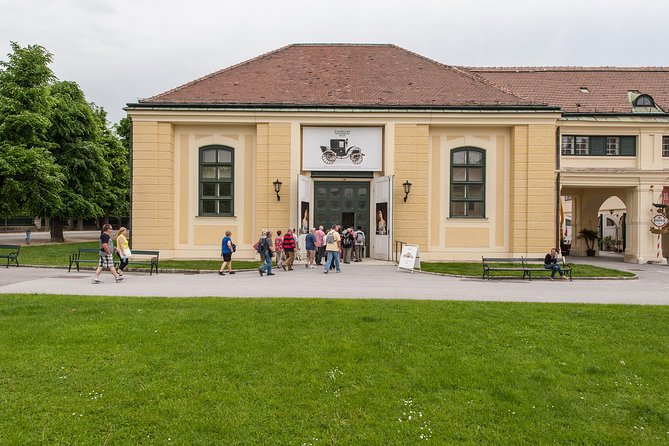
The Kaiserliche Wagenburg Wien is not simply a room full of old carriages. It shows how movement worked at the top of European society. A coach was a public stage, a status symbol, a practical vehicle, and sometimes part of a life-changing event.
You see carriages connected with Maria Theresia, Napoleon, and Emperor Franz Joseph. Their designs tell you something about the people who used them. A state coach communicates ceremony and rank. A travelling coach suggests long journeys and comfort. A child’s carriage brings the Habsburg household down to a more human scale.
I find this mix more useful than a display made up only of grand parade vehicles. The collection lets you compare formal power with private life. One minute you are looking at a vehicle built for a coronation, and the next you are seeing the smaller carriages made for imperial children.
The collection is also large enough to justify more than a quick glance. If you have only 45 minutes, concentrate on the Imperial Coach and the Sisi Trail. With an hour or more, stop at the labels and films, then look again at the details you missed on your first pass.
More ways into Schonbrunn Palace:
- Vienna: Schönbrunn Palace & Gardens Skip-the-Line Tour
★ 4.7 · 7,739 reviews - Vienna: Skip-the-Line Schönbrunn Palace & Gardens Tour
★ 4.8 · 5,411 reviews - Vienna: Bus & Schönbrunn Palace Skip-the-Line Guided Tour
★ 4.3 · 2,802 reviews
The Baroque Imperial Coach and the language of ceremony
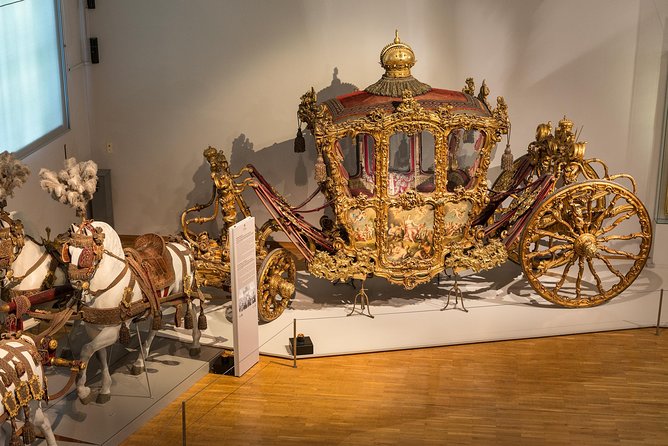
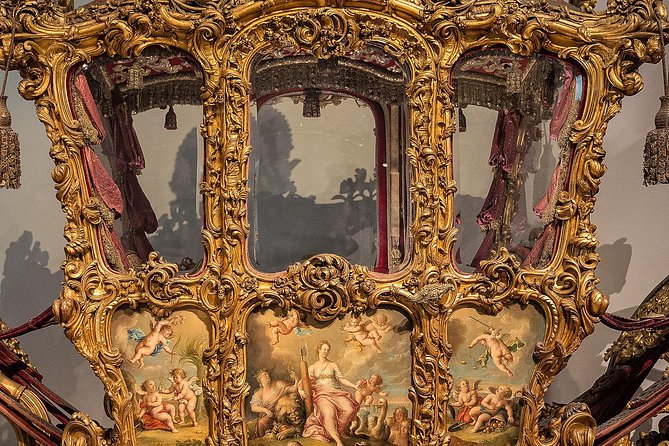
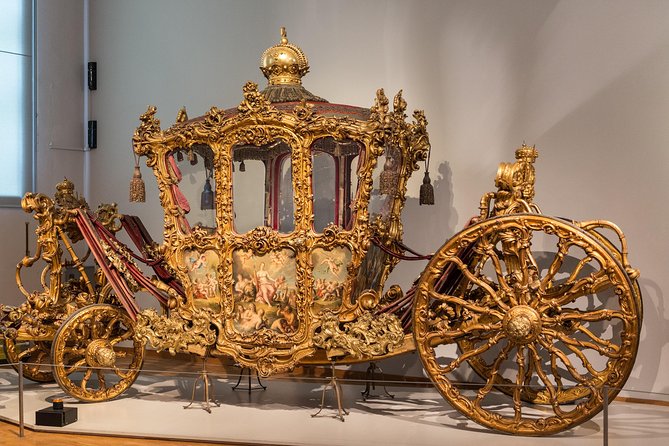
The Baroque Imperial Coach is the museum’s natural centerpiece. Its importance is not only its decoration. This was a vehicle designed to be seen, and every part of it helped project royal authority.
The coach gives you a direct picture of how a Habsburg ruler appeared in public. A royal procession was carefully staged, and the carriage formed part of that performance. You can read the vehicle as a piece of transport, but also as a mobile throne.
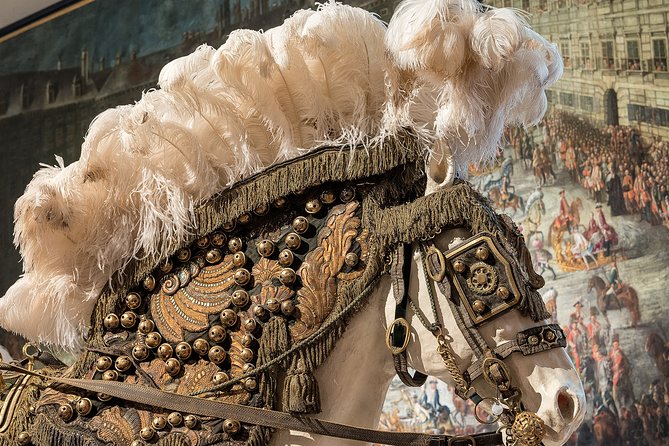
Around it, the state carriages help fill out the story. These were used for official duties and major occasions, while the travelling coaches were built with a different purpose in mind. The contrast is valuable because it prevents the museum from becoming one long parade of identical luxury.
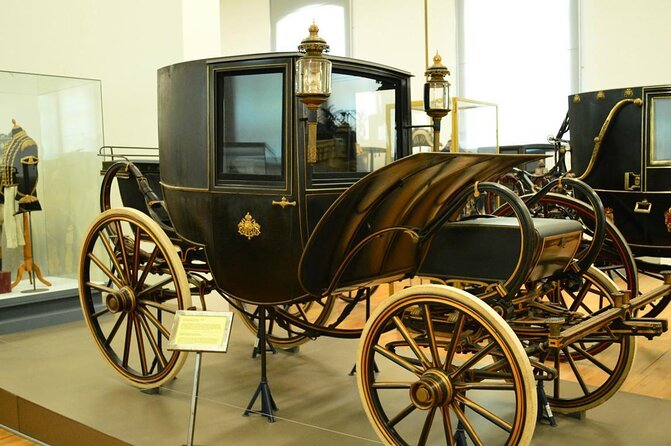
Look for the change in mood between the bright ceremonial vehicles and the darker, more solemn examples. The collection includes an impressive black hearse, which gives the final galleries a quieter tone. It reminds you that these carriages served the full cycle of court life, from celebrations to funerals.
Photography is allowed, according to the information provided, which is useful if you want to remember details in the painted panels, fittings, and carriage interiors. The lighting can be low in places, though, and one visitor found some objects difficult to see clearly.
The Sisi Trail follows Elisabeth from wedding to tragedy
The Sisi Trail is the museum’s most focused section. It follows Empress Elisabeth from her marriage into the Habsburg family through her public life, personal interests, assassination, and burial.
You begin with the coach associated with Elisabeth as an imperial bride. That starting point matters because it presents her before the familiar image of the restless, fashion-conscious empress took shape. The route then moves through important moments in her life using vehicles and original objects rather than relying only on portraits.
Among the strongest objects is the golden Imperial Coach used at her coronation as queen of Hungary. It gives you a sense of the public role Elisabeth was expected to play, even though her private life was often far removed from formal court ceremony.
The ending is especially direct. You can see the carriage from which Elisabeth alighted only minutes before her assassination in Geneva. Nearby is the black hearse that carried her to her final resting place. The two objects turn a famous story into a physical sequence: arrival, final journey, and mourning.
This section works best if you take time with the labels. The museum does not ask you to admire the vehicles only for their beauty. It links them to dates, events, and personal details, so the carriages become markers in Elisabeth’s life.
Elisabeth’s clothing, saddle, and unusual riding chapel
The Sisi Trail also includes objects that reveal the empress beyond ceremonies. Her sumptuous black robe, made around 1885 by Fanny Scheiner, is displayed with its exceptionally long train. The garment is closely tied to Elisabeth’s famous image and emphasizes the slender figure for which she was celebrated.
The robe is useful evidence of how much attention was paid to the empress’s appearance. It also adds a personal scale that a coach alone cannot provide. You are no longer looking only at the machinery of court life. You are looking at a garment shaped around one particular person and her public image.
Elisabeth was also known as a skilled horsewoman. The museum displays the only surviving saddle used by her, along with a reconstructed riding chapel. The latter includes portraits of her favorite horses, an unusual display that gives the empress’s equestrian interests a proper place in the story.
I like this part because it breaks up the sequence of large vehicles. The carriages explain how Elisabeth was presented to the world, while the saddle and horse portraits point toward the activities she valued for herself.
If you are mainly interested in Sisi, make this trail your priority. If you are visiting with children, the smaller Habsburg carriages may be more immediately appealing, while the clothing and personal objects offer older children a clearer connection to the people behind the displays.
More Museums in Vienna:
- Vienna: Skip-the-Line Sisi Museum, Hofburg and Gardens Tour
★ 4.8 · 5,918 reviews - Vienna Kunsthistorisches Museum Day Admission Ticket
★ 4.6 · 3,690 reviews - Tickets for the Albertina Exhibitions
★ 4.7 · 2,126 reviews - Vienna: Chocolate Workshop in Chocolate Museum w/ Tasting
★ 4.5 · 1,802 reviews
How long you need, and how to plan your visit
The stated duration is about 45 minutes, but that is a brisk visit. I would allow an hour if you want to read the explanations and watch the informational films. An hour and a half makes more sense if you are interested in the full collection rather than just the largest coaches.
The museum is open daily from 10:00 AM to 4:00 PM in the stated 2026 schedule, including January through February and March through December. A late visit can be pleasant because the museum may feel calmer near the end of the day, though you should still leave enough time before closing.
A simple plan works well:
- Visit the palace or gardens first.
- Walk over to the carriage museum near Schönbrunn.
- Start with the Imperial Coach.
- Follow the Sisi Trail in order.
- Return to the smaller carriages and travelling coaches if time allows.
The museum is close to public transportation, and transfers are not included. You arrange your own way there, but the location makes it easy to combine with a Schönbrunn day rather than treating it as a separate cross-town outing.
Do not assume that every Schönbrunn admission package includes this museum. One visitor found that even a Classic Plus pass required an extra payment. Check exactly what your palace ticket covers before you arrive.
Self-guided displays versus bringing a private guide
This is mainly a self-guided experience. Detailed explanations accompany the carriages, and informational films add context. The supplied description also refers to an audio guide, so you should expect interpretive material rather than a silent display, but a live guide is not included.
That arrangement suits me here. Carriages are objects you need to inspect from several angles, and you may want to pause at one coach while moving quickly past another. A fixed group talk can make that harder, especially in narrow hallways.
You can bring a private tour guide if you want a more personal explanation. The ticket itself covers admission, not guiding or transfers. There is no guide name attached to this experience, so do not book it expecting a named historian to meet you at the door.
Group size deserves a small warning. The stated maximum is 10 people, which would be a comfortable size for these galleries. Yet one account describes a group of 30 and difficulty seeing the objects in tight passages. If your confirmation shows a larger arrangement, consider arriving at a quieter time or using the written material at your own pace.
Is the $14.48 price good value?
At roughly $14.48 per person, the museum is reasonably priced by Vienna standards, especially if you already plan to visit Schönbrunn. You are paying for access to a specialized collection that includes royal vehicles, clothing, personal objects, and films, not just a single grand coach.
The value depends on your interests. If you love court history, transport, design, or Sisi, this is an easy choice. The collection gives you a different view of Schönbrunn and the Habsburg world, one based on travel, ceremony, family, and death.
If you have only a short time in Vienna and no interest in royal life, the price may be better spent elsewhere. The museum is focused, and its subject does not change much from room to room. It is not the place to visit if you want modern art, city history, or a broad survey of Austria.
Still, the modest cost helps. You do not need to give up half a day to see it, and the visit can fit neatly after the palace gardens. The fact that you can spend 45 minutes inside, or stretch the visit to 90 minutes, makes it flexible for a busy sightseeing day.
Crowds, lighting, and the practical details that matter
The museum can offer relief from the larger crowds at Schönbrunn Palace and in the gardens. That quieter feel is part of its appeal, especially if you want to examine the carriages without constant shoulder-to-shoulder traffic.
The narrow galleries are the main physical limitation. A big group can block a carriage and make it hard to follow an explanation. The collection is much easier to appreciate when you can step aside, read the panel, and return to the object.
Lighting is another minor issue. Some objects may be dimly lit, which protects the displays but can make details harder to see. Give your eyes a moment to adjust, and do not judge a carriage from the first angle you see.
Most people can take part, and the museum is near public transportation. No transfer is provided, so your ticket does not include transportation from a hotel or central Vienna.
Your mobile ticket should be ready when you enter. Confirmation is issued at booking, but one person had difficulty getting the ticket accepted after several exchanges with staff. That does not mean the ticket will fail, but it is sensible to keep the confirmation visible and allow a few extra minutes at the entrance.
Free cancellation is available if you cancel at least 24 hours before the scheduled start time. Changes or cancellations made within 24 hours are not accepted for a refund, and the local time in Vienna controls the cut-off.
Who will enjoy this museum most?
I would recommend it first to anyone who has already planned Schönbrunn and wants more than palace rooms and garden views. It adds the practical side of imperial life: how rulers travelled, appeared in public, raised their children, and were carried to funerals.
It is especially good for:
- History buffs who want objects linked to Maria Theresia, Napoleon, Franz Joseph, and Elisabeth.
- Sisi enthusiasts who want more than portraits and romantic stories.
- Families interested in the smaller children’s carriages and visual displays.
- Design-minded visitors who notice decoration, coach construction, clothing, and ceremonial detail.
- Short-stay visitors who need a compact museum near a major Vienna sight.
I would be less likely to choose it for someone who dislikes royal history or prefers a guided experience with a live expert. It also may frustrate anyone who needs a wide-open gallery and generous viewing space at every stop.
Should you book the Imperial Carriage Museum?
Book it if Schönbrunn is already on your Vienna plan and you want a focused museum that most palace visitors could easily miss. The Imperial Coach, Elisabeth’s Sisi Trail, the coronation vehicle, the black hearse, and her personal riding objects make the modest admission price worthwhile.
Give yourself at least an hour if possible, and visit before the 4:00 PM closing time rather than squeezing it in at the last minute. I would also check your palace pass, prepare your mobile ticket, and aim for a quieter period if you want to study the displays.
Skip it only if your schedule is packed or royal ceremony holds no interest for you. For everyone else, this is a compact, well-organized look at the Habsburgs through the vehicles that carried them.
FAQ
Where is the Imperial Carriage Museum located?
The Kaiserliche Wagenburg Wien is near Schönbrunn Palace in Vienna, Austria.
What does the ticket include?
The ticket includes entrance to the Imperial Carriage Museum.
Is a tour guide included?
No. A live guide is not included, though you can bring a private tour guide. The museum provides self-guided explanations and informational material.
Is an audio guide available?
The experience description includes an audio guide among its features. The displays also provide detailed explanations, and informational films are available.
How long does the visit take?
The approximate duration is 45 minutes. You can spend an hour or up to an hour and a half if you want to read the displays and see the full collection.
What are the museum’s opening hours?
The stated opening hours are daily from 10:00 AM to 4:00 PM throughout the provided 2026 schedule.
Is the museum near public transportation?
Yes. The museum is near public transportation, but transfers are not included with the ticket.
Can most people participate?
Yes. The activity information states that most people can participate.
How many people can join the experience?
The stated maximum is 10 people. One account describes a much larger group, so check the arrangement shown on your confirmation.
Can I cancel for a refund?
Yes. You can cancel at least 24 hours before the experience start time for a full refund. Cancellations or changes made less than 24 hours before the start time are not accepted for a refund.
More Skip the Line in Vienna
- Vienna: Skip-the-Line Entrance Ticket to the Danube Tower
★ 4.5 · 2,303 reviews - Vienna: Skip the Line Schönbrunn Palace and Gardens Guided Tour
★ 4.5 · 1,540 reviews - Vienna: Schönbrunn Palace & Garden Skip-the-Line Guided Tour
★ 4.1 · 1,240 reviews - Vienna: Skip-the-Line Schönbrunn Palace and Gardens Tour
★ 4.8 · 1,089 reviews
Recently added around Vienna
- Vienna: Private tour Mauthausen and Linz★ 4.1 · 3 reviews
- 2-Day Prague Tour from Vienna with private Transfers and Lunches★ 5.0 · 3 reviews
- Vienna Self Guided Sherlock Holmes Murder Mystery Game★ 4.5 · 3 reviews
- Vienna Private Schönbrunn Palace Tour, Extra Rooms and Gardens★ 5.0 · 3 reviews
- Salzburg and Lake Region Private Day Trip from Vienna★ 5.0 · 3 reviews
- Small-group Vienna Wine Tour★ 5.0 · 3 reviews
- True Crime mobile puzzle rally Vienna★ 4.0 · 3 reviews
- Exploring the Gutenstein Alps★ 5.0 · 3 reviews
Schonbrunn Palace Tours, compared.

Schönbrunn Palace & Gardens Skip-the-Line Tour
Read our review →
Skip-the-Line Schönbrunn Palace & Gardens Tour
Read our review →
Bus & Schönbrunn Palace Skip-the-Line Guided Tour
Read our review →
Skip the Line Schönbrunn Palace and Gardens Guided Tour
Read our review →
Schönbrunn Palace & Garden Skip-the-Line Guided Tour
Read our review →
Panorama Train Tickets to explore Schönbrunn Palace
Read our review →
Skip-the-Line Schönbrunn Palace and Gardens Tour
Read our review →Browse the lists this tour appears in