
Reviewed · BELVEDERE AND KLIMT TOURS
Private Klimt & Vienna Art Walk — From Baroque to Secession
Vienna’s art story comes into focus on this private walk, which links Klimt’s The Kiss at the Belvedere with his Beethoven Frieze at the Secession Building. Between those two famous works, you trace the city’s leap from imperial Baroque showmanship to the rebellious Art Nouveau of around 1900.
I like the private format, since your guide can adjust the pace and answer questions without a group crowding around. I also like the broad sweep: you see major art, palace gardens, churches, a Soviet memorial, Otto Wagner design, the Musikverein, and Naschmarkt in one morning or afternoon.
The main caution is that this is a serious walking and talking tour, not a light stroll. Museum tickets and public transportation are extra, and one guide, Walter, is known for offering strong personal views along with his art and history. That suits some people and will irritate others.
Key points to know before booking
- Klimt’s The Kiss is the main prize, with time at the Upper Belvedere devoted to the painting and the palace setting.
- The Beethoven Frieze at the Secession gives you a second, less familiar Klimt highlight.
- Walter is the guide most often identified by name, though one account also mentions Wolfgang, so your assigned guide may vary.
- Hotel, rental, pier, and station pickup is offered, but public transport and museum admission are not included.
- A private group of up to eight makes the $372.47 price far better for a full party than for one or two people.
- Allow for plenty of walking, with a moderate fitness level recommended and a four-hour schedule that can feel demanding after another walking tour.
Two Kisses, two eras of Vienna
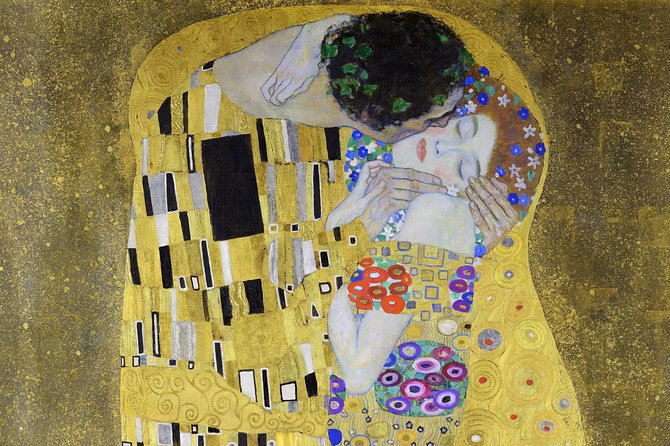
The tour is built around what the operator calls the Two Kisses: Klimt’s The Kiss at the Belvedere and the ending of the Beethoven Frieze at the Secession. That is a smart idea. You are not simply looking at two gold-covered Klimt works. You are comparing two settings and two stages in Vienna’s artistic life.
At the Belvedere, Klimt’s painting hangs in a former palace complex created for Prince Eugene of Savoy. At the Secession, Klimt’s work belongs to a building designed by artists who broke away from Vienna’s traditional art establishment. One setting speaks of courtly power. The other speaks of artistic rebellion.
Your guide connects those changes to Vienna around 1900, when Art Nouveau, psychology, music, and new ideas were reshaping the city. The tour also reaches back into the Baroque period, so Klimt does not appear as an isolated genius. You see the city that produced him, challenged him, and eventually made him one of its best-known artists.
More Walking Tours in Vienna
- Vienna: Guided Walking Tour of City Center Highlights
★ 4.7 · 4,989 reviews - Vienna: Vienna Central Cemetery Guided Walking Tour
★ 4.8 · 3,307 reviews - Vienna: Guided Walking Tour of City Highlights & Hidden Gems
★ 4.9 · 2,180 reviews
Entering the Belvedere gardens and Upper Belvedere
The tour begins at the Belvedere, with pickup available at your hotel, vacation rental, Vienna Central Station, Vienna West Station, or the Reichsbrücke pier. Other meeting points can be arranged. The standard start times are 9:30 a.m. and 2 p.m., which gives you a useful choice if your schedule is tight.
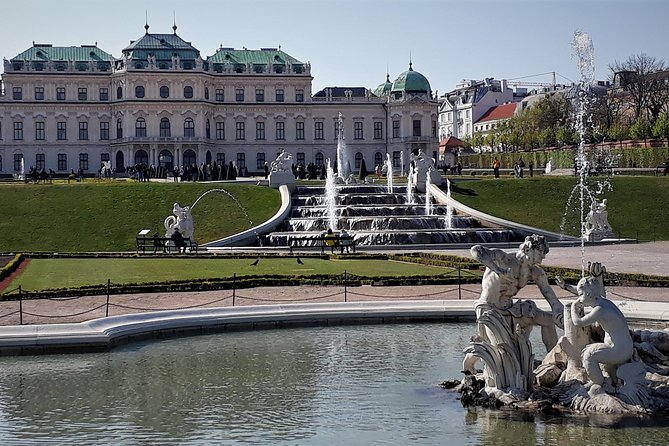
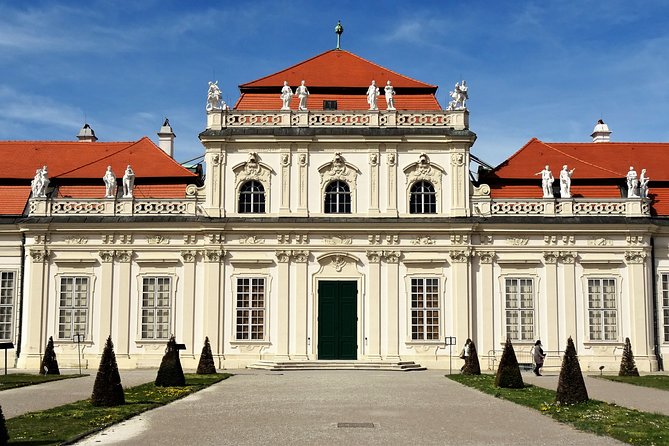
The wrought-iron gates open onto the Belvedere gardens, where the palace first reveals itself as a grand piece of theater. The garden rises in three levels, using terraces and sight lines to make the Upper and Lower Belvedere feel more imposing than their relatively compact scale might suggest.
Your guide explains the visual tricks as you walk downhill. This matters because the grounds are not just a pleasant garden between museum rooms. They were designed to present power from a distance, with the palace framed as the climax of the approach.
The visit to the Upper Belvedere lasts about 40 minutes in the planned schedule. The central reason to go inside is Klimt’s The Kiss, held in the Austrian Gallery. The painting’s gold surface is famous, but seeing it in person also lets you examine the different patterns on the figures’ clothing and the way Klimt turns a private embrace into a decorative icon.
The tour is described as including skip-the-line access, but admission is not included in the price. I would confirm exactly how the access works before departure, since you still need to pay for the Upper Belvedere ticket. The time-saving part can be valuable during busy periods, but it does not mean the museum visit is free.
This stop is especially good for first-time visitors to Vienna who want context rather than a quick photograph. The palace, gardens, and painting belong together. If you already know the Belvedere well, the visit may feel short, since 40 minutes leaves limited time for a broad museum collection.
Reading Prince Eugene’s smaller Versailles
On the way toward the Lower Belvedere, the guide interprets the garden rooms and honor court. The point is to show what Prince Eugene brought to Vienna from the Versailles style of royal display, only on a smaller scale.
That comparison gives the palace more meaning than a simple list of architectural dates. You see how aristocratic Vienna borrowed the language of French grandeur while adapting it to its own setting. The garden’s order, terraces, and formal views help you read Baroque design as a performance of rank.
I appreciate this part because it turns the walk outside the museum into part of the art lesson. You are not rushing from one famous painting to the next. You are learning how architecture, gardens, and political ambition worked as one package.
The schedule also refers to the Lower Belvedere, including the garden room and honor court. Exactly how much time you spend inside may depend on the pace of the day and the access arranged for your group. Ask your guide at the start if the Lower Belvedere interior is part of your visit or mainly being discussed from the grounds.
Schwarzenbergplatz and Vienna’s complicated 20th century
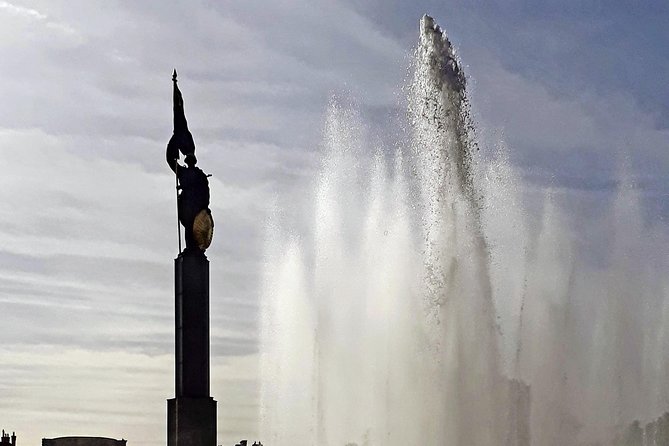
From the Belvedere area, the route reaches Schwarzenbergplatz. Its most visible feature is the Soviet Memorial, surrounded by buildings that reflect Vienna’s rapid growth at the end of the 19th century.
This is a useful change of mood after the palace. The square lets your guide move from imperial display to the political and architectural changes that followed. Vienna is not presented as a museum frozen in the Habsburg past. The Soviet Memorial brings the city’s postwar story into the walk.
This is also where Walter’s guiding style may matter. He is praised for linking art and history to present-day Austria, but he has also received a sharp complaint over political comments about NATO and Soviet-era Austria. The provider’s response makes clear that guides may share personal opinions on private tours.
I would treat this as a practical fit question. If you enjoy open discussion and a guide who adds personal interpretation, it may make the tour more lively. If you want a strictly neutral, tightly scripted explanation, you may prefer a different guide or a museum-only visit.
More Belvedere and Klimt visits:
- Entry Ticket Upper Belvedere, Klimt’s Kiss & Permanent Collection
★ 4.5 · 831 reviews - Vienna: Lower Belvedere Entry Ticket & Temporary Exhibitions
★ 4.1 · 275 reviews - Vienna: Belvedere Palace Skip-the-Line Tour
★ 4.9 · 197 reviews - Skip-the-line Upper Belvedere Tickets and Guided Tour Vienna
★ 4.8 · 185 reviews
Karlskirche and the best of Baroque Vienna
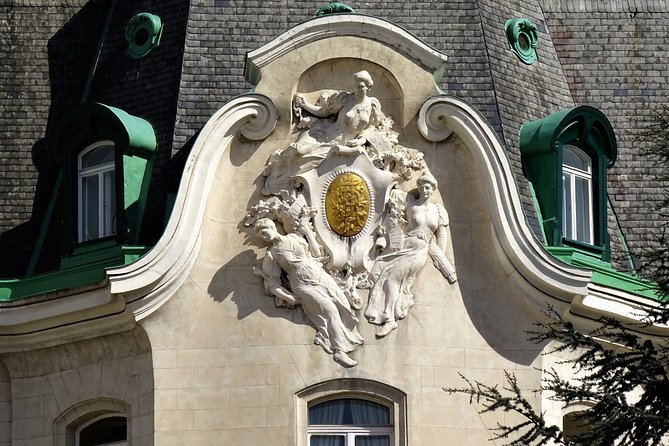
The route continues to Karlskirche, a church built to impress from a distance. Its Baroque design represents one of Austria’s grandest 18th-century moments, and the building gives you a strong visual counterpoint to the modern art that comes later.
The exterior is the key experience described here. Your guide explains how the church helps set the stage for Austria’s imperial glory. As with the Belvedere, the value comes from understanding the building as a public statement, not just admiring its columns and dome.
The walk then shifts forward in time at Karlsplatz, where Otto Wagner’s metro station offers a clean example of Vienna around 1900. The station is practical, but its ornament gives it the polish of a small civic monument. It shows how Art Nouveau entered everyday city life, not only galleries and private homes.
This contrast is one of the tour’s strongest teaching tools. Karlskirche uses Baroque grandeur to project authority. Otto Wagner uses modern materials and a more functional design language, yet still insists that public infrastructure can be beautiful.
Musikverein and Vienna’s musical identity
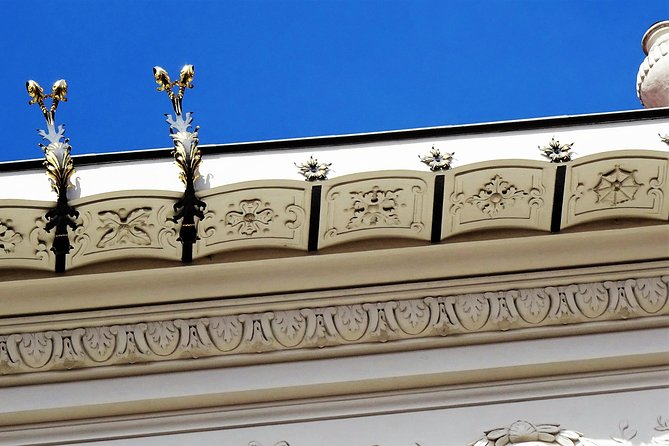
The Wiener Musikverein, home of the Vienna Philharmonic, appears along the route. Its Great Hall, also called the Golden Hall, is prized for its acoustics and is regarded as one of the finest concert spaces in the world.
The tour does not promise a concert or an interior performance visit, so think of this as an exterior and city-context stop unless your guide tells you otherwise. Even so, its presence helps connect the visual arts to Vienna’s musical culture.
Klimt’s Beethoven Frieze, discussed later, depends on that connection. Music, painting, and monumental public exhibitions were closely linked in Vienna around 1900. The Musikverein gives you another piece of that story before you reach the Secession.
Klimt’s Beethoven Frieze inside the Secession
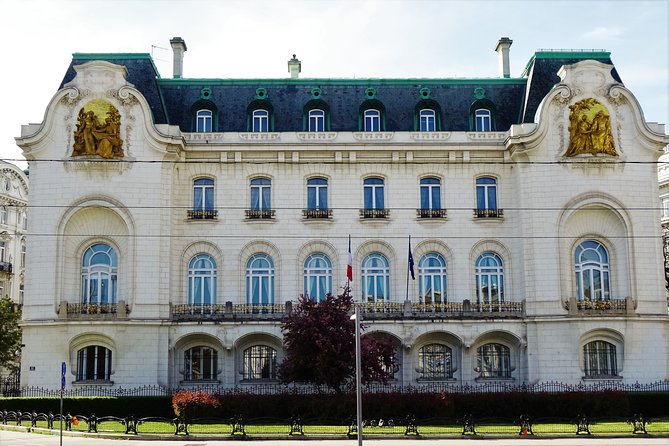
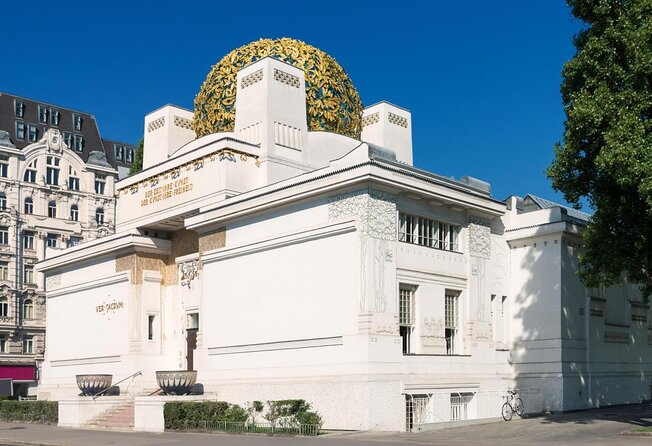
The Secession Building is the second major museum stop and lasts about 30 minutes in the planned itinerary. Its architecture is an Art Nouveau manifesto, created by artists who separated from Vienna’s established fine-art institution.
The building itself is worth your attention before you enter. Its unusual form announces that the old rules are being challenged. This is not a palace that uses art to reinforce a ruler’s status. It is an artists’ building making an argument about modern culture.
Inside, Klimt’s Beethoven Frieze was created for an exhibition honoring the composer. It was intended as temporary exhibition decoration and was painted directly onto the walls using light materials. The sequence ends with a kiss to the world, giving the tour its second Klimt embrace.
I find this work useful for understanding Klimt beyond the gold and romance of The Kiss. The Beethoven Frieze is more symbolic, unsettling, and tied to music and human struggle. Thirty minutes can be enough for a focused explanation, but it is not enough for a slow, independent study of every detail.
Admission is not included here either. The same rule applies as at the Belvedere: the tour price covers guiding and skip-the-line arrangements, not museum entry. Check the current ticket procedure when booking.
Naschmarkt and a practical finish
The final listed stop is Naschmarkt, whose present form dates to 1915. It combines a food market with an international eating area and can work well for lunch or a late-afternoon snack.
This is a pleasant way to finish a museum-heavy walk. You can ask your guide about the stalls, pause for food, or continue your day with a sense of how modern Vienna eats and socializes. The market is described as being in a transitional stage, so you should not expect a perfectly preserved old-world scene.
Naschmarkt also gives you a natural place to separate from the tour. If you choose the afternoon departure, it can lead into an early dinner or evening plans. If you choose the morning departure, it can supply lunch after several hours on foot.
How the four hours feel on foot
The experience is advertised at about four hours, though the exact pace can vary. One account describes a three-hour private tour, while another ended after roughly two hours because the participants’ feet hurt. The provider describes these as genuine half-day tours, so I would plan for three to four hours and avoid scheduling another walking tour immediately afterward.
You cover a lot of ground between the Belvedere, Schwarzenbergplatz, Karlskirche, Karlsplatz, Musikverein, Secession, and Naschmarkt. Public transportation may be used during the day, but it is not included. One especially positive account appreciated the guide taking the group to the metro and explaining the art and history along the way.
Wear comfortable shoes and bring enough energy for museum interiors, gardens, squares, and city streets. The stated requirement is moderate physical fitness. A guide can slow the pace, and Walter adjusted for a slower walker in one account, but this is still not the right choice if you need frequent seating or minimal walking.
Walter’s guiding style and the private format
Walter is the guide most closely associated with this experience. He has more than 40 years of travel and guiding experience and describes an academic background in art and history. His style is closer to an animated lecture than a tightly choreographed sightseeing show.
That can be a real advantage if you want explanations of Klimt’s life, his artistic circle, and the period around 1900. Specific praise has centered on the way he explains the art, answers questions, connects the paintings to Vienna, and adjusts the pace when needed.
His humor may feel dated, and his willingness to discuss politics is not for everyone. The strongest negative account objected to anti-American and pro-Soviet interpretations. I would not ignore that warning, especially if political neutrality matters to you. At the same time, the large majority of the supplied feedback describes the tour as educational, well paced, and worthwhile, with particular praise for Belvedere and the Beethoven Frieze.
The private format gives you more control than a standard group tour. Your party alone participates, up to eight people. You can ask for more Klimt, more architecture, or more Austrian history, though the four-hour limit means every extra question can reduce time at another stop.
Is $372.47 good value for your group?
At $372.47 per group, the math changes sharply depending on party size. Eight people pay about $47 per person before museum admission and transport. Four people pay about $93 each, while a couple pays about $186 each.
For a full family or group of friends, that can be a fair price for a licensed private guide, pickup, itinerary planning, and skip-the-line arrangements. You also avoid the rigid pace of a larger group. For two people, the cost is much harder to justify unless Klimt and Vienna’s art history are central priorities.
Remember the extra costs. Upper Belvedere admission is not included, Secession admission is not included, and public transportation is not included. Personal expenses, including food at Naschmarkt, are also yours.
Free cancellation is available if you cancel at least 24 hours before the local start time. Confirmation is sent within 48 hours of booking, subject to availability, so do not leave this until the last minute if your schedule is fixed.
Who should book this Vienna art walk?
I would choose this tour if you want Klimt explained in context, not simply pointed out. It suits first-time Vienna visitors who want a broad introduction to Baroque architecture, Art Nouveau, music, political memory, and museum art in one half-day.
It is also a good match for a private group that values hotel pickup and flexible conversation. Families with older children, art students, and adults who enjoy historical interpretation should get the most from it.
I would hesitate if you want a quiet, neutral, museum-focused experience, or if you dislike long explanations and personal opinions. I would also think twice if you already have a full day of walking planned, since the route covers substantial ground and the museum stops are brief.
Should you book it?
Book this private Klimt and Vienna Art Walk if you want two essential Klimt works plus the city story around them. The Belvedere gardens, Karlskirche, Otto Wagner station, Musikverein, and Secession make the tour much broader than a single museum visit.
For the best value, share the cost with a group of four to eight and confirm the ticket and skip-the-line arrangements before paying. Go in expecting an informed, opinionated guide, several hours on foot, and a focused look at Vienna from Baroque palace culture to Art Nouveau rebellion.
FAQ
How long is the Private Klimt and Vienna Art Walk?
The tour lasts approximately four hours. The planned museum portions include about 40 minutes at the Belvedere and 30 minutes at the Secession Building, with additional time for walking and city sights.
What are the starting times?
The tour starts at 9:30 a.m. or 2 p.m.
Where can the guide meet my group?
Pickup is offered at hotels and vacation rentals in Vienna, the Reichsbrücke pier, Vienna Central Station, and Vienna West Station. Other meeting points can be arranged.
Are museum tickets included?
No. Admissions to the Upper Belvedere and Secession Building are not included.
Is public transportation included?
No. Public transportation is listed as an additional expense.
How many people can join the private tour?
The private tour is for your group only, with up to eight people.
Can I cancel for a full refund?
Yes, if you cancel at least 24 hours before the experience start time. Cancellations or changes made less than 24 hours before the start are not refunded or accepted.
Recently added around Vienna
- Vienna: Private tour Mauthausen and Linz★ 4.1 · 3 reviews
- 2-Day Prague Tour from Vienna with private Transfers and Lunches★ 5.0 · 3 reviews
- Vienna Self Guided Sherlock Holmes Murder Mystery Game★ 4.5 · 3 reviews
- Vienna Private Schönbrunn Palace Tour, Extra Rooms and Gardens★ 5.0 · 3 reviews
- Salzburg and Lake Region Private Day Trip from Vienna★ 5.0 · 3 reviews
- Small-group Vienna Wine Tour★ 5.0 · 3 reviews
- True Crime mobile puzzle rally Vienna★ 4.0 · 3 reviews
- Exploring the Gutenstein Alps★ 5.0 · 3 reviews
Belvedere and Klimt Tours, compared.
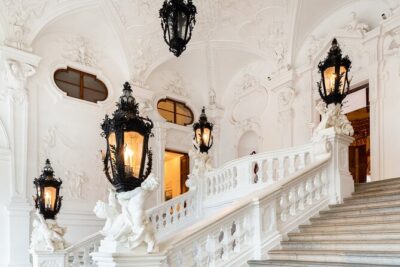
Entry Ticket Upper Belvedere, Klimt’s Kiss & Permanent Collection
Read our review →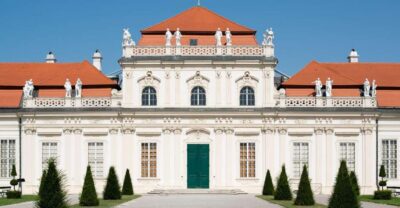
Lower Belvedere Entry Ticket & Temporary Exhibitions
Read our review →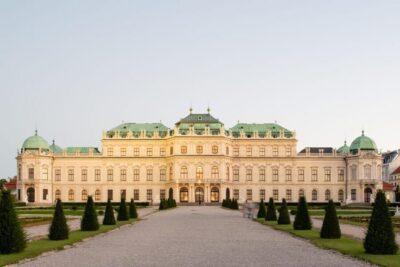
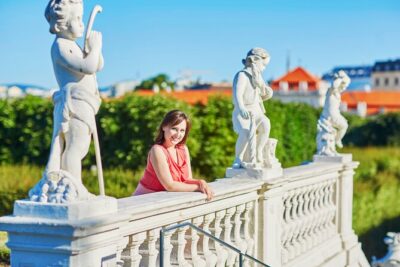
Skip-the-line Upper Belvedere Tickets and Guided Tour Vienna
Read our review →
Schönbrunn, Belvedere, Big Bus, Giant Wheel & Cruise
Read our review →
Skip-the-line Upper Belvedere Tickets and Guided Tour Vienna
Read our review →
Klimt Villa (Gustav Klimt Atelier & Museum) Ticket
Read our review →Browse the lists this tour appears in