
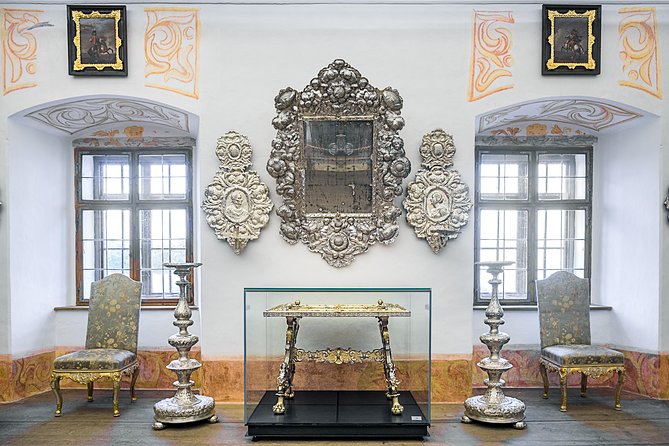
Reviewed · VIENNA TOURS
Forchtenstein Castle Entrance Ticket
Forchtenstein Castle gives you a rare look inside a private aristocratic collection, not just another pretty fortress. Behind its thick walls, you’ll find a 17th-century portrait gallery, an enormous armoury, chapel rooms, and a famous portrait of Vlad the Impaler, the historical figure linked to Dracula.
I like the freedom to explore without a fixed route, and I like that the visit brings together art, military objects, family history, and grand views in one compact stop. The main drawback is that the experience may feel repetitive if you are not keen on rows of similar portraits, and the castle can have limited parking.
- A 17th-century portrait gallery: See Esterházy princes alongside Attila the Hun, Charlemagne, and Vlad the Impaler.
- One of Europe’s largest private armouries: Examine weapons, armour, saddles, and objects tied to more than four centuries of military history.
- Huge inner-courtyard murals: Look up for secco paintings described as the largest of their kind north of the Alps.
- A self-paced visit: You choose the date and time, then move through the castle without a fixed itinerary.
- A dramatic hilltop setting: The castle offers broad views over the surrounding Burgenland countryside.
- A useful Vienna side trip: The castle is described as about an hour from Vienna, making it a practical excursion for history-minded visitors.
Why Forchtenstein Castle feels different from a standard castle tour
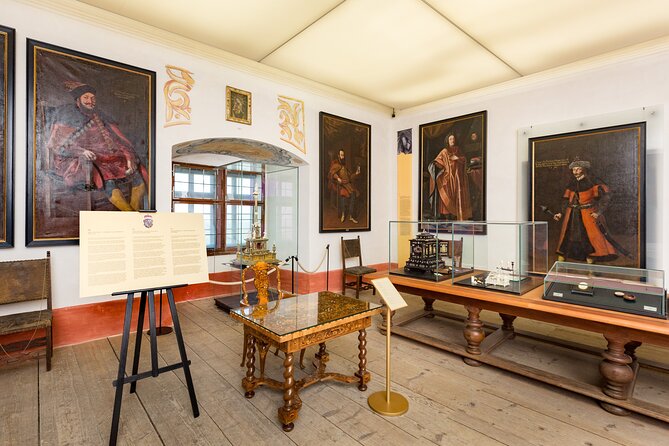
Many castle visits focus on rooms, furniture, and a few noble portraits. Forchtenstein takes a different route. The Esterházy family used this fortified place to preserve its military equipment, portraits, and collected objects, so the castle feels part fortress, part family archive, and part private museum.
That combination is the real reason to come. You are not simply walking through an empty shell with a nice view. The rooms hold weapons, armour, saddles, religious art, portraits, and objects linked to the family’s public image.
The castle itself dates back to the 1300s and has been carefully restored and maintained. Its thick defensive walls help you picture the building as a serious stronghold, while the interior collections show how the Esterházy princes wanted their power and ancestry remembered.
I would set aside one to two hours. That gives you enough time to see the main rooms at a comfortable pace, pause over the larger paintings, and enjoy the castle setting without turning the visit into an all-day commitment.
The inner courtyard and its enormous secco murals
Your first major surprise comes before the main galleries. Step into the inner courtyard and look up at the large secco murals. These paintings were made on dry plaster, and their scale is the point: they are described as the largest secco murals north of the Alps.
The courtyard gives you a strong sense of the castle’s size. Instead of entering a small historic house, you are crossing into a fortified complex built to impress and protect. The murals add ceremony to what might otherwise feel like a hard military space.
Take a moment here before hurrying inside. The courtyard also helps you understand the building’s design. Massive walls, enclosed passages, and high surfaces put the artistic displays in a defensive setting. That contrast, art inside a fortress, is one of the most memorable parts of the visit.
The murals may be more rewarding for some people than the later portrait rooms. They give you an immediate visual hit, while the collections require more patience and attention.
A few more Vienna half-days to weigh up
- Vienna: Vivaldi’s Four Seasons Concert in Karlskirche
★ 4.7 · 14,951 reviews - Vienna: Spanish Riding School Training
★ 3.9 · 9,281 reviews - Vienna: Skip-the-cashier-desk-line Giant Ferris Wheel Ride
★ 4.5 · 7,859 reviews
The chapel and oratory begin the indoor route
The castle visit starts with the oratory and chapel on the first floor. These rooms shift the tone from defense to devotion. They also remind you that this was a working aristocratic residence, not only a military storage place.
You can expect the chapel rooms to be more intimate than the large armoury and portrait displays. Look for the way religious spaces fit into a fortress built around security and status. The location of these rooms within the stronghold is part of the story.
The visit is not presented as a fixed, guide-led march from one room to the next. You can take your time, read the explanations, and decide where to linger. That works well if you prefer to study a painting or object instead of keeping pace with a group.
Still, the self-paced format has a tradeoff. Some of the written and audio explanations may feel basic if you already know a great deal about European dynasties or military history. The available information is useful for orientation, but it may not satisfy every specialist.
Four centuries of weapons, armour, and saddles
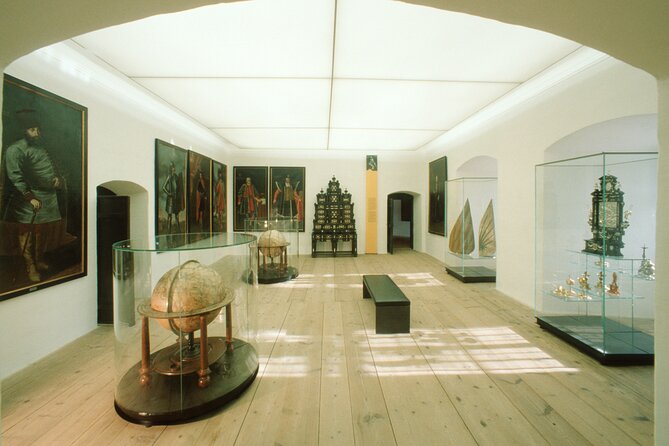
The military collection is one of Forchtenstein’s strongest reasons to visit. It is described as one of Europe’s largest private armouries, and the display covers more than 400 years of military history.
You’ll see weapons and armour connected to a long tradition of warfare and noble service. Saddles add another useful detail because they show the practical side of aristocratic military life. These are not just decorative objects. Together, they help explain how a powerful family displayed readiness, rank, and control.
I find armouries easier to appreciate when you look for patterns rather than individual pieces. Compare the shape and function of different weapons. Notice how much space is needed to store a military collection. Think about the difference between an object made for use and one preserved later as a family possession.
This section should appeal to you if you enjoy castles for their defensive purpose. It may be less gripping if your interest is limited to architecture or scenic views. The castle makes a strong effort to connect the objects to military tradition, but the displays still involve a large number of similar pieces.
The second floor turns toward the Esterházy family
The second floor presents the broadest range of collections. Here, the focus turns to the Esterházy family and the way its history was recorded through portraits.
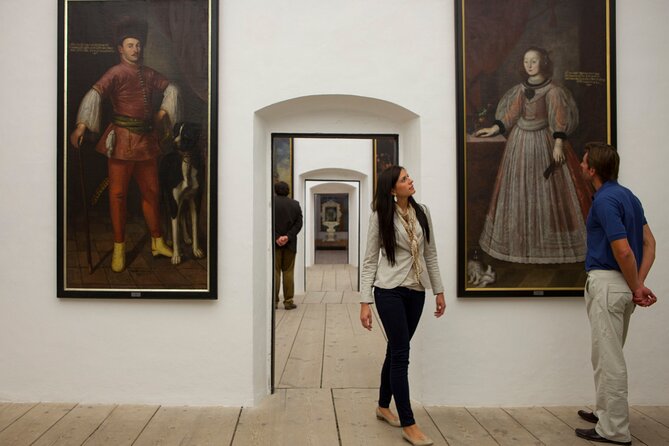
The paintings place Esterházy princes beside famous figures such as Attila the Hun, Charlemagne, and Vlad the Impaler. That arrangement is not simply a family album. It creates a grand story of ancestry, power, and connection to major figures from the European past.
The portrait gallery is one of the largest collections of Baroque portraiture in Europe. You can expect full-size paintings, formal poses, elaborate clothing, and faces that repeat a familiar aristocratic language. The scale matters. A full-length portrait was designed to project rank, wealth, and authority, not just to record a likeness.
The highlight for many people will be the portrait of Vlad the Impaler. The connection with Dracula gives the painting an easy hook, but the historical figure is more interesting than the fictional character alone. If that is the image you most want to see, keep in mind that the castle contains much more than one famous portrait.
I would give this floor extra time if you enjoy art history. If rows of similar portraits tire you quickly, move at a steady pace and focus on the unusual subjects, clothing, symbols, and differences in pose. Some of the written interpretation may feel elementary, so you may need to bring your own curiosity to the display.
A different way to spend an afternoon here:
- Vienna: Schönbrunn Palace & Gardens Skip-the-Line Tour
★ 4.7 · 7,739 reviews - Vienna: Light of Creation Votive Church Immersive Light Show
★ 4.8 · 6,779 reviews - Vienna Spanish Riding School Guided Tour
★ 4.7 · 6,765 reviews - Vienna: Classical Concert in the World-Famous Musikverein
★ 4.6 · 6,673 reviews
The castle’s collections tell a story of power
Forchtenstein’s collection is valuable because it shows how a noble family built and protected its public identity. Weapons communicate military strength. Portraits connect the family to famous rulers and heroes. Religious rooms show status and devotion. The fortress itself supplies the physical proof of security.
That makes the visit more useful than a simple list of objects. You can read the castle as a statement made in stone and paint. The Esterházy family wanted you to see continuity, authority, wealth, and service across generations.
At the same time, the collection does not seem designed to deliver a modern, tightly edited museum experience. You may find many similar paintings and objects grouped together. Some people will appreciate the sheer scale. Others may wish for clearer organization and livelier explanations.
I would not recommend rushing through the rooms just to say you saw everything. Pick several portraits, weapons, or decorative objects and examine them closely. The displays reward attention more than speed.
Views, setting, and the value of the visit
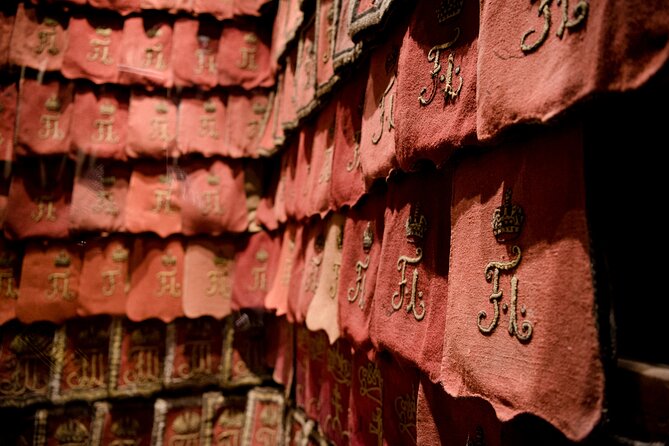
The castle’s position is one of its safest strengths. From its elevated setting, you get wide views across the surrounding countryside. Even if the indoor displays are not your main interest, the location gives you a reason to slow down outdoors.
The view also explains the castle’s defensive logic. A high position offers control and visibility, while the heavy walls provide protection. You can connect the scenery to the building’s original purpose instead of treating the outlook as a separate photo stop.
At $22.11 per person, the ticket is fairly priced if you plan to spend the full one to two hours with the collections. You are paying for access to a substantial private armoury, a major portrait display, unusual historical objects, and a carefully maintained medieval fortress.
The value is less certain if you only want a quick look at the exterior. The indoor collections are the main reason to pay admission. If your interests lean toward architecture, weapons, or aristocratic art, the price makes more sense. If you prefer a polished, highly interactive museum, you may find the visit less satisfying.
Check your other regional admission benefits before buying. A Burgenland-Card has been accepted for free entry, so cardholders should confirm its current terms before paying separately.
Planning a visit from Vienna
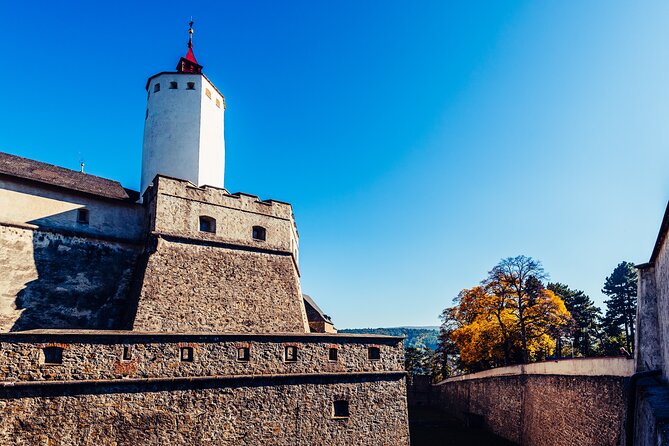
Forchtenstein Castle is in Burgenland, at Burggasse, 7212 Forchtenstein. The journey is described as about an hour from Vienna, so this works best as a planned side trip rather than an attraction you add casually between central Vienna sights.
The ticket lets you choose a date and time that fits your schedule, and advance booking guarantees admission. That matters most during the busier summer period, when opening hours extend across all seven days.
Opening hours are seasonal:
- From April 1 through May 31, the castle is open Tuesday through Sunday from 10 a.m. to 5 p.m.
- From June 1 through August 31, it is open daily from 10 a.m. to 5 p.m.
- From September 1 through October 31, it is open Tuesday through Sunday from 10 a.m. to 5 p.m.
The castle is open for long enough to avoid a rushed visit, but do not assume every day operates on the same schedule. Check the date you want before setting out.
Parking may be limited, so plan extra time if you are driving. The supplied information does not give a detailed transport plan from Vienna, so confirm your route and allow for the castle’s location outside the city center.
Confirmation arrives when you book. Service animals are allowed, and most people can take part. Those points make the visit broadly accessible, though the available information does not describe every surface, stairway, or indoor access detail.
Is this castle best with a guide?
The ticket gives you freedom to explore at your own pace, and the castle has explanations for the objects. Some feedback also refers to two different guided tours, but the ticket information here does not specify their names, schedules, or whether they are included.
That means you should not book this particular admission expecting a named guide or a guaranteed guided tour. Treat it as flexible castle entry, then confirm separately if a guided option is important to you.
A self-guided visit suits you if you like choosing your own pace. You can spend more time with Vlad’s portrait, move quickly through repeated portraits, or pause in the armoury without holding up a group.
The downside is that interpretation may not always give you the depth you want. If you prefer a clear story delivered by a person, check the day’s tour options before you visit.
Who will enjoy Forchtenstein Castle most?
I would recommend this experience to you if you enjoy:
- Medieval fortresses and military architecture
- Weapons, armour, and saddles
- Baroque portraiture
- Aristocratic family collections
- Unusual historical figures such as Vlad the Impaler
- Short cultural excursions from Vienna
- Flexible visits without a fixed group route
Families with older children may find the armour and Dracula connection an easy way into the history. Art lovers should focus on the portrait gallery, while castle enthusiasts should pay close attention to the defensive structure and inner courtyard.
You may want to skip it if you dislike museums with many similar portraits or if you need a very polished audio guide. The setting is dramatic, but the indoor experience depends on your interest in the collection.
How to get the most from your one to two hours
Start in the courtyard and look at the murals before entering the exhibition rooms. This gives you a sense of scale and makes the transition into the chapel and oratory more meaningful.
Next, slow down in the military displays. Do not treat the armoury as a wall of objects. Look at how weapons, saddles, and protective gear reflect changing military needs and noble status.
On the second floor, choose a few portraits instead of trying to inspect every face. Compare the presentation of Esterházy family members with the portraits of famous historical figures. Notice how clothing, stance, and scale communicate rank.
Save time for the views. The surrounding countryside is part of the appeal, and it provides a welcome break after enclosed rooms filled with paintings and armour.
Finally, if you are driving, allow time to deal with limited parking. A little planning will make the visit feel calm rather than hurried.
Should you book the Forchtenstein Castle ticket?
Book it if you want a compact but substantial castle visit near Vienna, especially if you care about private collections, military objects, or Baroque portraiture. The courtyard murals, the huge armoury, the Esterházy portraits, and the Vlad the Impaler connection give the castle several distinct points of interest.
I would be more cautious if your main goal is a highly interactive museum or a guided presentation with detailed storytelling. The self-paced format gives you freedom, but the displays may feel repetitive and some explanations may seem too simple.
At $22.11, the ticket earns its price when you use the full visit and take time with the collections. Book ahead if the castle fits your schedule, but check for a valid Burgenland-Card before paying. Free cancellation is available until 24 hours before the start time, which gives you some useful flexibility.
FAQ
Where is Forchtenstein Castle located?
Forchtenstein Castle is located at Burggasse, 7212 Forchtenstein, Austria.
How long does a visit take?
The visit takes approximately one to two hours.
How much does admission cost?
The listed price is $22.11 per person.
Can I choose my visit date and time?
Yes. You can choose a date and time that suits your schedule when booking.
Is advance booking required?
Advance booking is used to guarantee admission. It is especially useful if you want to visit on a particular day or during the summer season.
When is the castle open from April through May?
From April 1 through May 31, the castle is open Tuesday through Sunday from 10 a.m. to 5 p.m.
When is the castle open during June, July, and August?
From June 1 through August 31, the castle is open daily from 10 a.m. to 5 p.m.
Are service animals allowed?
Yes. Service animals are allowed.
Can I cancel my ticket for a refund?
Yes. You can cancel up to 24 hours before the experience start time for a full refund. Changes or cancellations made less than 24 hours before the start time are not accepted for a refund.
Recently added around Vienna
- Vienna: Private tour Mauthausen and Linz★ 4.1 · 3 reviews
- 2-Day Prague Tour from Vienna with private Transfers and Lunches★ 5.0 · 3 reviews
- Vienna Self Guided Sherlock Holmes Murder Mystery Game★ 4.5 · 3 reviews
- Vienna Private Schönbrunn Palace Tour, Extra Rooms and Gardens★ 5.0 · 3 reviews
- Salzburg and Lake Region Private Day Trip from Vienna★ 5.0 · 3 reviews
- Small-group Vienna Wine Tour★ 5.0 · 3 reviews
- True Crime mobile puzzle rally Vienna★ 4.0 · 3 reviews
- Exploring the Gutenstein Alps★ 5.0 · 3 reviews
Vienna Tours, compared.

Vivaldi’s Four Seasons Concert in Karlskirche
Read our review →

Skip-the-cashier-desk-line Giant Ferris Wheel Ride
Read our review →
Schönbrunn Palace & Gardens Skip-the-Line Tour
Read our review →
Light of Creation Votive Church Immersive Light Show
Read our review →

Skip-the-Line Sisi Museum, Hofburg and Gardens Tour
Read our review →