
Reviewed · VIENNA TOURS
Private Vienna Music Tour
The best part of this private Vienna music tour is the way it connects famous composers to real city streets. You begin inside the Vienna State Opera, then walk through the old town to places tied to Beethoven, Mozart, Johann Strauss, the Vienna Boys Choir, and St. Stephen’s Cathedral. It gives you music history with a map under it, not just a list of names.
I like the flexible private format, especially for families or mixed-interest groups. I also like the guide-led entry into the State Opera, where you can hear about conductors such as Gustav Mahler and see more than the usual street view. The main catch is important: the opera ticket is not included in the $450.09 group price, even though skip-the-line access is provided.
Key points to know before booking
- The Vienna State Opera comes first: You get a behind-the-scenes tour with skip-the-line access, but you must pay the admission fee separately.
- The walk covers major music landmarks: Expect Palais Lobkowitz, the Hofburg Imperial Chapel, Mozart’s memorial, a Johann Strauss site, Beethoven’s former home, and St. Stephen’s Cathedral.
- The private group can include up to 15 people: The set price can make better sense for a family or small group than for one or two people.
- Lisa receives especially strong praise: Her lively delivery, flexibility, and ability to include children and teens are recurring strengths.
- Hotel pickup may be available: If you stay in Vienna’s inner city, the guide can pick you up at your hotel.
- The tour lasts about two and a half hours: It is a useful first-day introduction, but it is not a full concert experience or a substitute for an evening at the opera.
Why this tour works as a first look at Vienna
Vienna can feel like one grand monument after another. The State Opera, Hofburg, Stephansplatz, and old-town lanes are all close together, but without context they can blur into a parade of ornate façades. This tour gives those buildings a storyline built around music.
You start at the Vienna State Opera on Opernring, then finish at Stephansplatz. That route matters. You are not being driven from one isolated sight to the next. You move through the central city and see how imperial Vienna, church music, opera, court culture, and famous composers fit together.
I would book this near the beginning of a Vienna stay. One family scheduled it late and wished they had done it sooner because the walk helped them understand the city’s layout. That is useful advice. After two and a half hours with a guide, you will have a better sense of where the opera house, Hofburg, old town, and cathedral sit in relation to one another.
The tour is private, so your guide can adjust the balance. If your group wants music above all else, the discussion can stay with composers, performances, and musical institutions. If you also want architecture, imperial Vienna, or general city orientation, the guide can fold those subjects into the walk. Lisa is particularly well suited to that flexible approach, based on the way she has handled families, children, and groups with mixed interests.
A few more Vienna half-days to weigh up
- Vienna: Vivaldi’s Four Seasons Concert in Karlskirche
★ 4.7 · 14,951 reviews - Vienna: Spanish Riding School Training
★ 3.9 · 9,281 reviews - Vienna: Skip-the-cashier-desk-line Giant Ferris Wheel Ride
★ 4.5 · 7,859 reviews
Inside the Vienna State Opera for about 45 minutes
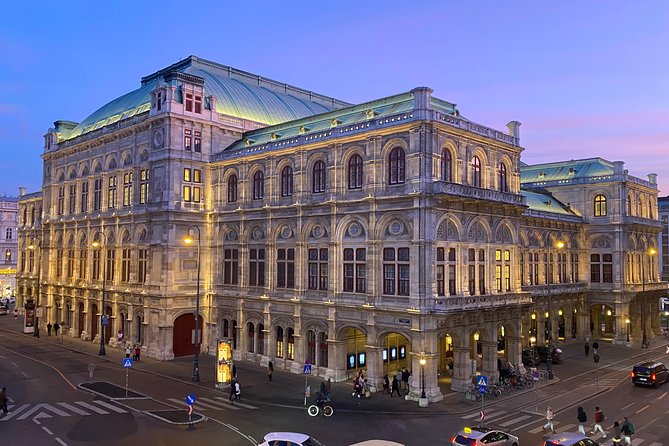
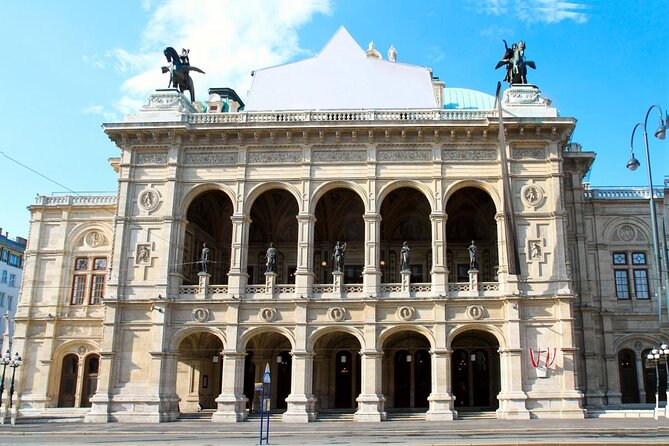
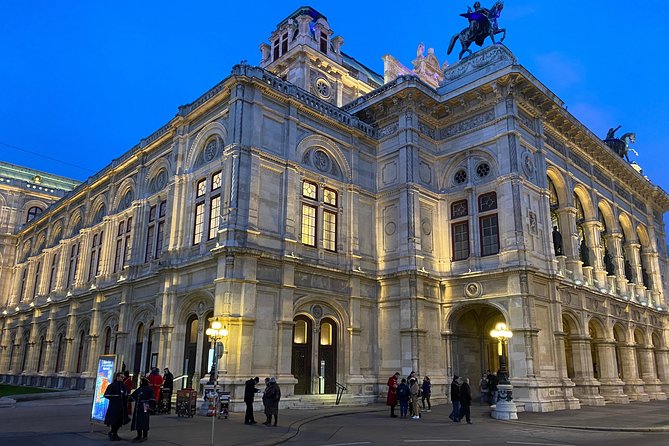
The first major stop is the Wiener Staatsoper, one of Vienna’s defining buildings and one of the world’s best-known opera houses. Your state-certified Austria Guide introduces its past and takes you behind the scenes for about 45 minutes.
That behind-the-scenes element is the real reason to choose this tour over a standard old-town walk. You are not only looking at the opera house from the Ringstrasse. You get access inside, with the guide explaining the building and its role in Vienna’s musical life.
The commentary includes famous conductors such as Gustav Mahler. That helps put the house in a larger setting. The opera is not simply a pretty nineteenth-century building. It is a working cultural institution tied to the city’s long performance tradition.
There is one booking detail you need to understand before you pay. The tour provides skip-the-line access, but the State Opera admission fee is extra. You will pay for the opera ticket at the entrance. The published price of $450.09 covers your private guide and tour service, not the opera admission itself.
That changes the value calculation. For a group of 10 to 15, $450.09 is about $30 to $45 per person before the opera ticket. For two people, it is a much larger expense per person. The private setting and personal attention may justify that price for a special occasion, but couples on a tight budget should compare it with a regular group tour.
The exact interior access can depend on the opera house schedule and operating conditions. One guest used the tour during the off season and said the guide made the visit work when it was difficult to figure out independently. That is a useful advantage, though you should still confirm the current opera admission arrangements when booking.
Palais Lobkowitz and Beethoven’s Eroica
After the opera house, the tour turns into a music-themed walk through Vienna’s old town. One of the first key stops is Palais Lobkowitz, a palace linked to Ludwig van Beethoven and his main patron.
This is where Beethoven premiered his Symphony No. 3, known as the Eroica. That detail gives the building unusual weight. You are not just seeing another aristocratic palace. You are standing at a place connected to a major change in Beethoven’s work and public reputation.
A good guide can make this sort of stop land with a non-specialist. You do not need to know every symphony number before arriving. The value is in hearing how a composer’s career connected to patrons, grand rooms, and Vienna’s social world.
Palais Lobkowitz also helps explain why composers came to Vienna. Music was not separate from court life or wealthy households. Patronage opened doors, funded performances, and gave musicians a place in the city’s elite circles. That context is more useful than a quick plaque reading.
The Hofburg Imperial Chapel and the Vienna Boys Choir
The next stop is the Hofburg Imperial Chapel, associated with performances by the Vienna Boys Choir every Sunday. This is a short but meaningful part of the route, especially if you are considering attending a service or hearing the choir during your stay.
The chapel connects the city’s musical life to the Habsburg court. Here, music was part of worship and ceremony, not just a ticketed evening event. Your guide can help you see the chapel as part of the larger Hofburg complex rather than as a separate sight.
This stop may be especially useful for families. Children who are less interested in composer biographies can often connect with the idea of a famous choir performing in a grand imperial setting. The private format also lets you ask practical questions about Sunday performances.
Do not confuse this tour with attendance at a Vienna Boys Choir performance. The experience takes you to the chapel and explains its importance, but the tour does not include a choir concert.
A different way to spend an afternoon here:
- Vienna: Schönbrunn Palace & Gardens Skip-the-Line Tour
★ 4.7 · 7,739 reviews - Vienna: Light of Creation Votive Church Immersive Light Show
★ 4.8 · 6,779 reviews - Vienna Spanish Riding School Guided Tour
★ 4.7 · 6,765 reviews - Vienna: Classical Concert in the World-Famous Musikverein
★ 4.6 · 6,673 reviews
Mozart, memory, and the old town
The walk continues to a memorial dedicated to Wolfgang Amadeus Mozart, Vienna’s most famous resident. Mozart’s connection to Vienna is one of the city’s most familiar stories, but the guide’s role is to make the memorial part of a larger route instead of a quick photo stop.
You can expect discussion of Mozart’s life in Vienna and his place in the city’s identity. The stop is brief compared with a full museum visit, so it works best if you want orientation and storytelling rather than a long display of manuscripts and objects.
This is another reason the tour suits a first visit. You get a series of touchpoints. Later, if Mozart catches your interest, you can decide which museum, concert, or historic residence deserves more of your time.
The guide’s flexibility matters here. One family specifically wanted information beyond music, and Lisa adjusted the experience to include wider city subjects. That is worth requesting when you book or at the start of the walk. You are paying for a private guide, so make the most of that freedom.
Johann Strauss and Vienna’s waltz tradition
The route includes a former dance salon connected with Johann Strauss, the Waltz King. This stop shifts the mood from Beethoven’s serious symphonic world to the social pleasure of dance.
Vienna’s waltz tradition is not just a musical footnote. It reflects how music entered public life, parties, court events, and popular entertainment. A former dance salon gives you a physical setting for that story.
This part may appeal to people who do not think of themselves as classical music fans. The subject is social and easy to picture. You can think about the room as a place where music, fashion, manners, and courtship all met.
The wording of the stop suggests a former dance venue rather than a full museum visit. Do not expect a long indoor presentation devoted to Strauss. It is one piece of a moving city walk, with the guide supplying the meaning.
Beethoven’s former residence
The tour returns to Beethoven with a stop at one of his former residences. Vienna has several Beethoven-related sites, so this experience is best understood as an exterior landmark and storytelling stop unless your guide tells you that interior entry is arranged.
The value is personal connection. You hear where Beethoven lived while moving through the same central city associated with his work. That can make his story feel less abstract than it does in a concert program.
It also gives your guide a chance to explain the practical side of a composer’s life in Vienna: homes, patrons, performance rooms, and the city’s compact center. The tour does not present Beethoven as a name floating above the city. It places him in actual streets and buildings.
If Beethoven is your main reason for booking, ask in advance which residence is included and whether the stop is exterior only. The supplied details do not promise admission to a Beethoven house museum.
St. Stephen’s Cathedral closes the route
The final stop is St. Stephen’s Cathedral, Vienna’s famous Gothic landmark in Stephansplatz. The cathedral has several music connections: Mozart was married there, Haydn performed as a chorister for eight years, and many other stories tie the building to Vienna’s musical life.
Ending here makes good practical sense. Stephansplatz is central, easy to find, and close to many cafés, shops, churches, and transit links. You can continue sightseeing on your own after the guide leaves.
The cathedral also broadens the tour beyond opera and composers. Sacred music was a major part of Vienna’s identity, and St. Stephen’s shows how religious, civic, and musical life overlapped.
As with the chapel, this is a guided visit and explanation, not a guaranteed concert or special interior performance. If you want to attend a church concert, ask separately about current programs. Lisa once tried to help a group find concert tickets, even checking availability for them, but tickets were already sold out. That is a reminder that concert plans need their own booking strategy.
Lisa’s guiding style and the private format
The strongest feature of this experience is the guide. Lisa is repeatedly described as lively, friendly, attentive, and easy to talk with. Her style seems to work especially well when a group includes children, teens, and adults with different levels of interest.
That matters because music history can become dry fast. A guide who can explain architecture, answer side questions, and use humor when appropriate keeps the walk moving. Lisa has also made an effort to identify herself clearly before meeting, including telling one group what she would be wearing. That small detail can save time at a busy meeting point.
The private format gives you room to set the pace. A group of eight ranging from teenagers to seniors found the walk manageable, and a group with two children appreciated the care taken to include everyone. Still, the tour lasts about two and a half hours and includes walking through the central city. Wear comfortable shoes and tell the guide early if your group needs a slower rhythm.
The maximum group size is 15. That is private in the sense that no unrelated group joins you, but 15 people is not a tiny party. For the best personal exchange, I would expect the experience to feel most intimate with two to eight people.
Price, timing, and what you actually receive
The listed cost is $450.09 per group of up to 15. The included service is a state-certified, accredited Austria Guide. Pickup may be offered from hotels in the inner city, and otherwise you will receive an exact meeting location before the tour.
The tour operates Monday through Sunday from 9 a.m. to 4 p.m. during the stated operating period of April 3, 2025 through October 12, 2026. The start point is the Vienna State Opera, and the usual finish is Stephansplatz.
The biggest value comes from combining three things in one booking:
- A private guide for your group
- A State Opera visit with skip-the-line access
- A focused walk through several central music landmarks
The opera admission surcharge keeps the price from being completely all-inclusive. Add that cost before comparing this tour with other options. If you are traveling with a large family or group of friends, the fixed group rate can be reasonable. If you are alone or traveling as a couple, a public tour may cost less.
The tour is offered in English and uses a mobile ticket. Confirmation arrives at booking. Service animals are allowed, public transportation is nearby, and most people can participate. Those details make it easy to fit into a normal Vienna sightseeing day.
Who should book this Vienna music tour
I would choose this experience for:
- Families who want a guide who can keep children and adults involved
- First-time visitors who want city orientation along with music history
- Classical music fans who want the State Opera and composer connections in one outing
- Small groups that can share the fixed price
- Visitors who prefer questions and conversation over a recorded audio guide
- People visiting outside the main opera season who want help arranging a State Opera visit
I would think twice if you want a full concert, a long museum visit, or a low-cost introduction to Vienna. This is a guided overview, not an evening performance and not an in-depth study of one composer.
Should you book it?
Book this private Vienna music tour if you want the city’s music story tied to real places, and if your group values a flexible guide. Lisa appears to be a particularly strong match for families and mixed-interest parties, with a warm style and plenty of energy.
Before booking, ask about the current State Opera admission fee and confirm which areas you will enter. Remember that the opera ticket is extra. If you are a larger group, the $450.09 rate can offer fair value. For just one or two people, the private treatment is a luxury.
For a first day in Vienna, this is a smart route: opera house first, old town next, cathedral last. You finish with a better sense of the city and several ideas for what to see or hear afterward.
FAQ
How long does the Private Vienna Music Tour last?
The tour lasts approximately 2 hours and 30 minutes.
What language is the tour offered in?
The tour is offered in English.
Is the Vienna State Opera admission included?
No. Skip-the-line access is included, but the State Opera entrance fee is not included. You pay the admission fee at the entrance.
Where does the tour start and finish?
It starts at the Vienna State Opera at Opernring 2, 1010 Vienna, and ends at Stephansplatz, 1010 Vienna.
Is hotel pickup available?
Pickup may be available if your hotel is in Vienna’s inner city. If it is not, you will be contacted before the tour with an exact meeting location.
How many people can join the private tour?
The price covers one private group of up to 15 people. Only your group participates.
Can I cancel for a full refund?
Yes. You can cancel at least 24 hours before the experience start time for a full refund. Changes or cancellations made less than 24 hours before the start time are not accepted for a refund.
Recently added around Vienna
- Vienna: Private tour Mauthausen and Linz★ 4.1 · 3 reviews
- 2-Day Prague Tour from Vienna with private Transfers and Lunches★ 5.0 · 3 reviews
- Vienna Self Guided Sherlock Holmes Murder Mystery Game★ 4.5 · 3 reviews
- Vienna Private Schönbrunn Palace Tour, Extra Rooms and Gardens★ 5.0 · 3 reviews
- Small-group Vienna Wine Tour★ 5.0 · 3 reviews
- Salzburg and Lake Region Private Day Trip from Vienna★ 5.0 · 3 reviews
- True Crime mobile puzzle rally Vienna★ 4.0 · 3 reviews
- Exploring the Gutenstein Alps★ 5.0 · 3 reviews
Vienna Tours, compared.

Vivaldi’s Four Seasons Concert in Karlskirche
Read our review →

Skip-the-cashier-desk-line Giant Ferris Wheel Ride
Read our review →
Schönbrunn Palace & Gardens Skip-the-Line Tour
Read our review →
Light of Creation Votive Church Immersive Light Show
Read our review →

Skip-the-Line Sisi Museum, Hofburg and Gardens Tour
Read our review →