
Reviewed · GRAZ TOURS
Universalmuseum Joanneum Pass in Graz
Graz packs an impressive amount of culture into one pass. The Universalmuseum Joanneum ticket opens 12 museums and cultural sites across the city and wider Styria, from a world-famous armoury to a floating blue contemporary-art center and a grand Baroque palace.
I like the freedom to choose your own route, and I like the contrast between venues. You can spend the morning with medieval weapons, the afternoon looking at Austrian modern art, and the next day exploring Roman finds or rural life. The pass is also a sensible buy if you plan to visit several sites rather than just one.
The main catch is practical: you must print your Viator booking confirmation and show it at the cashier point to receive the paper pass. A digital QR code may not be enough, and guided tours or audio guides cost an extra €2.50 per person.
Key points to know before you go
- Twelve very different museums: The pass covers art, science, archaeology, architecture, rural life and military history.
- Choose 24 or 48 hours: The longer option gives you breathing room for sites outside central Graz.
- The Styrian Armoury is the star attraction: Its enormous collection of historical weapons makes it unlike most European museums.
- Eggenberg Palace needs time: Its 24 state rooms and more than 500 ceiling paintings reward a slower visit.
- The museums are not all in one building: You create the schedule, but you also need to plan around locations and opening times.
- Bring a printed confirmation: The pass is issued at the cashier point, and digital ticket handling has caused problems for at least one customer.
What the Joanneum pass actually gives you
The Universalmuseum Joanneum is not one museum with a single entrance. It is a network of 12 institutions spread through Graz and parts of Styria. Your 24-hour or 48-hour pass lets you shape the experience around your interests.
That matters because the collection is unusually broad. You are not locked into one subject or one style of building. You can move from Roman archaeology to natural science, then from aristocratic interiors to contemporary sculpture.
The listed price is $24.08 per person. That is strong value if you visit three or more sites, especially the larger attractions such as Eggenberg Palace, the Styrian Armoury and Kunsthaus Graz. If you only want one museum, buying a single admission may make more sense, but the pass rewards curiosity and a full day of museum-going.
The shorter pass suits a focused Graz visit. The 48-hour version is the better choice if you want to include a site beyond the city center, such as the Austrian Sculpture Park or one of the museums in Stainz, Trautenfels, Alpl or Krieglach. The pass gives you access, but you still need to handle your own transport and timing.
A few more Graz half-days to weigh up
- Kunsthaus Graz Museum Entrance Ticket
★ 3.5 · 19 reviews - Graz: Old Town Highlights Private Walking Tour
★ 4.6 · 16 reviews - Fun & mobile scavenger hunt through Graz
★ 4.5 · 12 reviews
Start in Graz’s old town with the Styrian Armoury
If you have time for only one museum, I would begin with the Styrian Armoury. It is described as the world’s largest historical weapons arsenal, and the scale is the point. This is not a small display of swords behind a few glass cases. The collection presents the military equipment of past centuries in a way that helps you picture the practical side of warfare.
The armoury is especially useful for visitors who want history without a long academic lecture. Rows of armour, weapons and equipment show how soldiers were protected, armed and organized. The objects make the past physical and immediate.
Allow at least an hour, and longer if military history interests you. The pass itinerary allows about two hours for the Universalmuseum Joanneum experience, but you control your own pace. Add time for the surrounding Altstadt von Graz, where several central attractions can fit naturally into the same outing.
The old town also gives you easy variety. After the armoury, you can switch from military history to painting at the Neue Galerie, natural science at the Natural History Museum, or contemporary art at Kunsthaus Graz. That mix is one of the pass’s best features.
See Austrian art at the Neue Galerie
The Neue Galerie covers a broad stretch of Austrian and international art. Its collections include Biedermeier, Jugendstil, expressionism and classic modernism, along with Austrian and international painting after 1945.
I like this stop for visitors who want a quick sense of how artistic tastes changed over time. Biedermeier works can feel orderly and domestic, while Jugendstil brings decorative lines and design. Expressionism then shifts the mood toward stronger emotion and less natural forms.
The gallery is a useful counterpoint to Eggenberg Palace. At the palace, you look at art as part of aristocratic rooms and ceremonial spaces. Here, painting and artistic movements take the lead.
Do not try to rush through every period just to claim another entrance. Pick the sections that match your interests. If you are visiting with children or with someone who tires quickly in art museums, the pass lets you leave without feeling that you wasted the entire admission fee.
Visit Natural History Museum for a change of pace
The Natural History Museum offers a very different experience. Its displays include wild cats, birds in flight, unusual plants, fossils and other examples of the planet’s variety.
This is a good reset after several rooms of paintings or historical interiors. You can focus on the visual impact of the specimens, or use the displays to give younger family members a stronger reason to join the museum day. The attraction is described as suitable for most participants, and service animals are allowed.
The museum also helps explain why this pass works better than a narrow art ticket. Graz’s museum offering is not built around one subject. You can follow your mood, switching from culture to science when you need a change.
A different way to spend an afternoon here:
- Graz Scavenger Hunt and Sights Self Guided Tour
★ 4.0 · 9 reviews - Graz city tours
★ 3.5 · 9 reviews - Explore Graz in 60 minutes with a Local
★ 5.0 · 7 reviews - Graz Private Walking Tour With A Professional Guide
★ 5.0 · 5 reviews
Make time for Eggenberg Palace
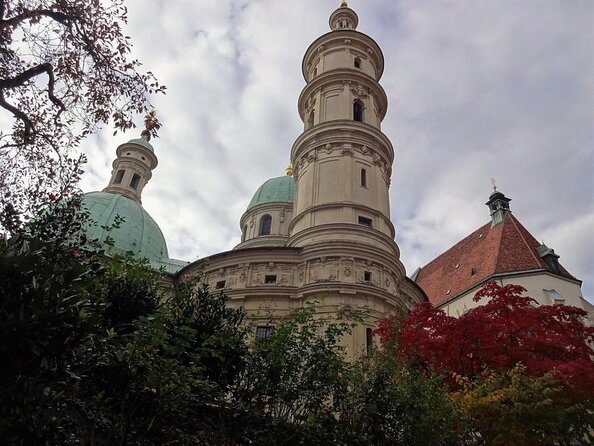
Eggenberg Palace sits at the edge of the city center in a beautiful park. The palace’s main draw is its 24 state rooms, original interiors, historic furniture and more than 500 ceiling paintings.
This is not a quick photo stop. The rooms work as a complete decorative program, so give yourself enough time to look upward and notice how the ceilings relate to the rooms below. The historic furniture adds context, while the palace itself shows how power and ceremony were presented in an aristocratic home.
I would reserve one of your longer visits for Eggenberg. It is one of the places where the 48-hour pass earns its keep, since you can visit without squeezing it between too many central museums.
The park adds breathing space before or after the interiors. Still, do not assume the palace is simply another old-town stop. It sits at the edge of the center, so check your route and allow time to reach it. The pass includes admission, not a guided visit or transport service.
Find modern Graz at Kunsthaus Graz
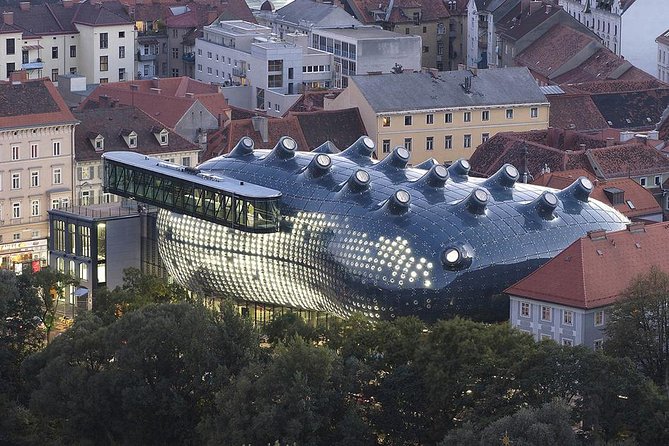
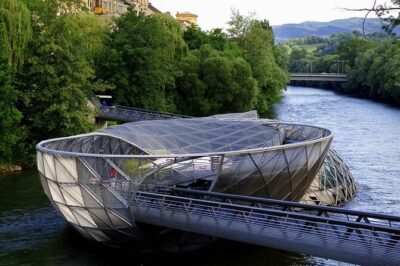
Kunsthaus Graz looks like a mysterious blue balloon floating among the roofs of the historic center. Its unusual shape is part of the attraction, but the interior is devoted to contemporary art.
This is where the Joanneum pass meets present-day Graz. After the armoury and palace, Kunsthaus feels deliberately different. It gives you a look at modern exhibition design and contemporary work rather than historical collections.
The building is a good choice if you want a museum that feels tied to the city around it. You do not need to be an expert in modern art to appreciate the contrast between the old town’s traditional buildings and this striking blue form.
Because contemporary exhibitions can be more dependent on personal taste, I would pair Kunsthaus with a museum you already know you want to see. That way, the pass remains good value even if every installation does not appeal to you.
Explore Roman Styria at Flavia Solva
The Roman Museum Flavia Solva takes you beyond Graz to the only Roman city within modern Styria. Its archaeological material includes finds, inscriptions and reliefs from the former province of Noricum.
This stop is for you if Roman history, archaeology or the development of provincial cities interests you. It adds a regional layer that central Graz museums cannot provide. You are not just looking at imperial Rome in the abstract. You are seeing evidence from the Roman world in the territory that became Styria.
The drawback is time. Since the site is outside central Graz, it is not an easy add-on to a short old-town museum circuit. It makes more sense with the 48-hour pass and a separate plan for reaching the site.
Meet Peter Rosegger in Alpl and Krieglach
The pass includes two places linked to Styrian writer Peter Rosegger, who lived from 1843 to 1918.
At Rosegger’s Birthplace in Alpl, furnishings and personal items show rural life in the 19th century. This is less about grand art and more about daily conditions, household objects and the world in which Rosegger grew up.
Rosegger Museum Krieglach occupies his former country home. It follows stages in his life and work and gives you a second setting in which to understand the writer’s connection to Styria.
These stops suit readers who want local culture rather than only major monuments. They also make the pass useful for a broader regional trip. The practical warning is simple: neither belongs to a quick walk between Graz’s central museums, so do not add them casually to a packed 24-hour plan.
See sculpture outdoors at the Austrian Sculpture Park
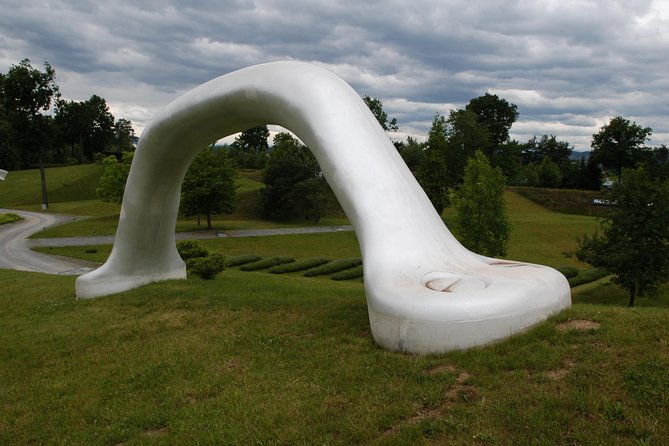
The Austrian Sculpture Park presents contemporary works ranging from abstract sculptures and human figures to pieces based on household and practical objects.
The open setting changes the pace again. Instead of moving from room to room, you see art in a place designed for walking and relaxation. The park is child-friendly, making it one of the more flexible choices for families.
I would use this as a lighter stop between indoor museums. It gives you room to move and lets you discuss the sculptures without the quiet, enclosed feel of a gallery. Your reaction may depend on how much you enjoy contemporary art, but the outdoor format makes the visit less demanding.
The park is also one of the reasons to consider 48 hours. Since the 12 sites cover the wider region, the pass works best when you avoid treating every location as part of one frantic day.
Visit hunting and regional collections at Stainz and Trautenfels
Schloss Stainz houses Austria’s largest Hunting Museum. Its displays focus on historical weapons and equipment, making it a natural companion to the Styrian Armoury.
The two sites are not identical. The armoury presents a major arsenal in an urban setting, while Stainz places hunting material inside a castle. If you have a strong interest in weapons, hunting or historic equipment, visiting both gives you useful contrast.
Schloss Trautenfels offers zoological, geological and mineralogical displays, along with archaeological finds from the region. The castle also contains high-quality Baroque interiors and views of the surrounding mountains.
Trautenfels is a strong choice if you want several subjects in one stop. You can look at natural science, regional archaeology and decorative rooms without changing museums. As with the other outlying locations, plan it as a dedicated excursion rather than assuming the pass eliminates travel time.
Add the Folk Life Museum for everyday history
The Folk Life Museum has collected, preserved and interpreted material objects connected with social life and individual lives since 1913.
This is the kind of museum that can give a place human scale. Grand palaces and military collections show institutions and power. Folk objects point toward work, home and ordinary routines.
The museum may suit you best if you prefer social history to famous masterpieces. It also balances the Joanneum’s art museums and major monuments. You can learn about Styria through things people used, kept and passed on, not only through paintings and official buildings.
Planning a 24-hour or 48-hour route
For a 24-hour visit, keep your plan central and focused. A practical pairing might include the Styrian Armoury, the Natural History Museum, the Neue Galerie and Kunsthaus Graz, with time in Graz’s old town between stops. Add Eggenberg Palace only if you are willing to give it proper time and organize the journey there.
For 48 hours, spread the experience out. Use the first day for central Graz, then choose one or two regional sites on the second day. Eggenberg Palace, the Austrian Sculpture Park, Flavia Solva, Stainz, Trautenfels, Alpl and Krieglach all require more thought than simply walking into another old-town museum.
The pass is flexible, but flexibility is not the same as a ready-made tour. There is no guided group, fixed route or included audio guide. English, German, partly Italian and Slovenian audio guides or guided options can be bought separately for €2.50 per person.
Bring the printed booking confirmation to the cashier point. The pass is a paper ticket, and the digital side of the process may not work as smoothly as you expect. One customer specifically reported waiting two days without receiving an email containing a usable QR code. Printing the confirmation before you leave home is the safest move.
Confirmation is provided at booking, and free cancellation is available up to 24 hours before the local start time. Changes or cancellations made within that final 24-hour period are not accepted for a refund.
Who should buy this pass?
I recommend it most strongly to museum fans, families with mixed interests and visitors spending at least two days around Graz. It is also useful if you want to combine major city attractions with less familiar regional sites.
You should think twice if you only have a few hours or care about one museum alone. The pass covers admission, but it does not remove the need to plan routes, check timing or pay for guidance.
The experience receives an overall rating of 4.1 from 14 ratings, which suggests a generally positive but not flawless experience. The strongest reason to book is not a guided explanation. It is the freedom to build a varied museum visit around your own interests.
FAQ
How long is the Universalmuseum Joanneum pass valid?
You can choose a 24-hour or 48-hour pass.
How many museums and cultural sites are included?
The pass includes admission to 12 museums and cultural institutions.
Does the pass include guided tours or audio guides?
No. Guided tours and audio guides are not included. They can be purchased separately on site for €2.50 per person. Available languages are English, German, partly Italian and Slovenian.
What should I bring to receive the pass?
Print your Viator booking confirmation and show it at the cashier point. The pass is issued as a paper ticket.
Is the pass suitable for visitors with service animals?
Yes. Service animals are allowed, and most people can participate.
Can I cancel for a full refund?
Yes, if you cancel at least 24 hours before the experience start time. Cancellations or changes made less than 24 hours in advance are not accepted for a refund.
Recently added around Graz
- Private Photoshoot Walk Old Town of Graz★ 3.0 · 3 reviews
- Graz Old Town Highlights Private Walking Tour★ 5.0 · 4 reviews
- Graz Private Walking Tour★ 4.9 · 4 reviews
- Graz: Funicular Ride & Schlossberg Picnic Experience★ 4.8 · 4 reviews
- Graz Private Walking Tour With A Professional Guide★ 5.0 · 5 reviews
- Graz Funicular Ride and Schlossberg Picnic Experience★ 5.0 · 5 reviews
- Explore Graz in 60 minutes with a Local★ 5.0 · 7 reviews
- Graz Scavenger Hunt and Sights Self Guided Tour★ 4.0 · 9 reviews
Graz Tours, compared.

Graz Funicular Ride and Schlossberg Picnic Experience
Read our review →
Browse the lists this tour appears in